Best Dog Bowls for Hiking and Road Trips

Dog bowls – the first thing I pack for any road trip. Finding the best travel dog bowl for hiking and road trips can make all the difference in your adventure. Whether you’re hitting the trails or taking a road trip, having the right portable bowl is key to your dog’s comfort and hydration. Here are a few notes to help you choose the best bowl, plus some of the best dog bowls for hiking and travel that work for us. 

MuttRuk RollOut Travel Bowl

I may earn a commission or revenue on some items through the links below. This does not affect your price or savings. I appreciate your support!

Types of Portable Dog Bowls for Travel and Hiking

What makes the best travel dog bowl can vary for each dog owner and canine company, but here are some dog bowl types to consider:

  • Foldable Dog Bowls: These bowls typically have a fabric exterior and a waterproof or water-resistant interior, making them both durable and lightweight.
  • Collapsible Dog Bowls: These bowls, typically silicone, are space-saving and portable, perfect for outdoor activities.
  • Fixed-Form Silicone Dog Bowls: These dog bowls are sturdy and can stand up to extended use. While they don’t collapse, they are great for longer trips or when your dog needs a full-sized bowl.
  • Fixed-form Plastic, Ceramic, or Stainless Steel Bowls: These are the regular non-collapsible bowls you might use at home. I have ceramic bowls and stainless steel bowls for Lu at home. Consider them for stationary trips like car camping, van life, or long road trips.

What to Look for in the Best Dog Bowls for Travel and Hiking

At home, most dog guardians (myself included) use ceramic or metal bowls. And these are great for the stationary home. But they’re heavy and bulky to fit in a backpack for a dog-friendly hike. Less is more for travel as well. That’s where the dog bowls designed for travel come into play.

What to look for in the best portable dog bowl:

  • Collapsibility: A dog bowl that will collapse or fold down to a smaller size saves space in your backpack or car. More room for snacks!
  • Weight: If you’re a backpacker or hiker, you don’t want a heavy bowl in your backpack or your dog’s backpack. This is where the fabric bowls win as an ultralight dog bowl, without a doubt. But the collapsible silicone bowls are still fairly lightweight and a great option for road trips and more.
  • Waterproof or Water Resistant: Not all travel dog bowls are meant for water. And for those that are, some are more waterproof than others. Many fabric bowls are only intended for a quick drink on the go, and they may only be water-resistant. If you’re camping, you will want something that can hold water all day.
  • Capacity: How much water does the bowl need to hold? Small dogs drink less than large dogs. Whoa, what?! Yeah, wild, I know. 
  • Durable: Many of the collapsible dog bowls are made of silicone, which is quite durable. But also consider any other materials used, such as a plastic top edge that could crack or break over time. And don’t discount those fabric bowls in this category! Most foldable, fabric-type bowls use a 600-denier fabric, which is durable enough to stand up to your backcountry treks or inner-city strolls.

​What is Denier? It’s a unit of measurement used to determine the fiber thickness of individual threads used in the creation of fabrics. Fabrics with a high denier count are thicker and more durable. Those with a low denier count are softer and silkier.

​Best Foldable Dog Bowls for Hiking

​These are the most compact and packable dog bowls for hiking. Ultralight dog bowls are typically made of a 600-denier polyester outer layer and a waterproof interior.

MuttRuk: RollOut Travel Bowl

Price: $20 at muttruk.com

Features: Waterproof, collapsible, includes a carabiner for easy attachment, and rolls up for easy storage

Best For: Quick access during hikes and adventures

This is my current go-to dog travel bowl for outdoor adventures (I have it in two colors!). MuttRuk has thought of everything for this bowl: flexible, durable, waterproof material that rolls up and secures with a snap; plus, a small carabiner to hook the bowl right to your dog water bottle or the side of your pack, leash, etc. You don’t even have to take off your backpack to access the bowl—unclip it, unroll it, and fill it with water from your hydration pack. It is a great option for pet parents with a small or large dog.

Ruffwear: Quencher

Price: $20 at ruffwear.com

Features: Durable fabric, water-resistant, folds easily, loop for carabiner attachment.

Best For: Lightweight, short hikes, and city strolls.

I received the small version of the Ruffwear Quencher in an outdoors subscription box several years ago. It was a great win back then and still is. Packable and durable. It also has a loop to attach a carabiner. 

(Note: The Outward Hound bowl pictured below is no longer available.)

MuttRuk RollOut Travel Bowl
Ruffwear Quencher Travel Bowl

Top Collapsible Dog Bowls for Travel

These dog bowls collapse flat. They aren’t quite as compact and light as the foldable bowls, but they are sturdier. I prefer these when I know we’ll have a home base, such as when we’re camping or on a road trip. You can leave the bowl full of water all day, and it won’t leak.

Kurgo: Collapse A Bowl

Price: $13 at kurgo.com

Features: Collapsible, comes with a carabiner, easy to store

Best For: Road trips and outdoor adventures

I love this bowl and have it in three colors! I leave one in the car for emergency water needs and use the other two during road trips. Because they collapse down flat, they fit right in the dog food container without taking up any extra space. I like the Kurgo Collapse A Bowl as a dog food bowl because it’s easy to clean. Plus, they have small carabiners to attach to a backpack if you take them hiking, etc. 

Ruffwear: Bivy Collapsible Dog Bowl

Price: $30 at ruffwear.com

Features: Durable fabric, water-resistant, folds easily, lightweight

Best For: Short hikes and city strolls

I don’t remember how I wound up with this bowl (I think in another subscription box), but it was my first introduction to a collapsible dog bowl not made of silicone. What’s important about that? It weighs a lot less, another great ultralight dog bowl option. The wide base of this bowl keeps it stable. This is helpful as pups are running around, or with enthusiastic eaters, when used as a dog food bowl.

Kurgo Collapse A Bowl on the left, Ruffwear Bivy Collapsible Bowl on the right

​Best Silicone Dog Bowls (Fixed Form)

Not the type of bowl you’d toss into your backpack for a hike, but a fixed-form silicone bowl is perfect for road trips and extended camping adventures. The collapsible bowls are durable, but my dogs inadvertently collapse them partway if I leave the bowls out unattended. This is where a fixed-form bowl comes in handy: hotels, campsites, in the car, etc. 

Sleepy Pod: Yummy Travel Bowl

Price: $36 at sleepypod.com

Features: No-spill, durable design, interlocking bowls for food and water

Best For: Extended trips like camping, road trips

I received this bowl set in a gift bag at a car-safety event. Legit the best thing I’ve ever received in a gift bag! It doesn’t pack down smaller, but it is still well-designed for travel. The inner bowl was too small to use as a food bowl for Cool Whip and Hercules, but it would be perfect for a small dog. The no-spill water bowl is a significant upgrade for road trips. Bonus: I accidentally ran it over once and didn’t do a bit of damage.

Kurgo: Splash-Free Wander Dog Water Bowl

Price: $14 at kurgo.com

Features: No-spill, durable design, less expensive

Best For: Extended camping and road trips

If you don’t need the interlocking food bowls, this no-splash water bowl from Kurgo could be a great alternative. One significant difference with this bowl is its angled design. The base is wedge-shaped so you can set it on the car seat and the water will still sit level for easy drinking. Note: I have not tried Kurgo’s no-splash bowl.

Sleepy Pod Yummy Travel Dog Bowl
A silicon dog bowl survives being run over!

How to Choose the Right Dog Bowl for Your Trip

The type of bowl you choose should depend on various factors, including your dog’s size, the nature of your trip, the weather conditions, and the balance between portability and durability.

Consider Your Dog’s Needs

Some dogs may require more hydration than others, especially during strenuous hikes. If you know your dog tends to drink more often or during exercise, opt for a larger or deeper bowl. Additionally, if your dog is prone to drinking rapidly, look for a non-spill bowl to avoid making a mess.

For small dogs, a compact, collapsible bowl will usually suffice. Larger dogs will likely need a bowl with more capacity. Durability and stability also become more important for larger dogs, so consider a sturdier material.

Type of Adventure

The type of adventure you’re embarking on can greatly influence the best dog bowl for the job. Whether it’s a quick day hike or an extended camping trip, the right bowl will differ based on the trip’s duration, location, and accessibility.

  • Backpacking or Multi-Day Hikes: For backpacking trips where you’re trekking with your dog for several days, a collapsible bowl is usually the best option, as it can be rolled or folded up to save space. However, you may also want to bring a more durable bowl for meal times, especially if you’re in an area with limited water sources. Bowls that roll up work great for space-saving and can handle outdoor wear and tear.
  • Short Day Hikes or Quick Trips: If you’re going on a short hike, a collapsible or foldable bowl is typically the best option. These bowls are compact, lightweight, and easy to pack, making them perfect for short excursions. They can be stowed away in your backpack or clipped to your gear when not in use. Collapsible bowls are great for dogs that don’t need a large amount of water or food throughout the day.
  • Weekend or Extended Camping Trips: For longer trips like camping, durability and capacity become more important. You might need to choose a fixed-form bowl or silicone bowl that can hold more water and withstand longer use. If you’re planning to leave water out for your dog all day, a bowl that doesn’t collapse and offers a spill-resistant design is essential. Silicone bowls tend to perform well for this because they are stable and won’t collapse under pressure, even when your dog drinks or eats from them multiple times a day.

Portability vs. Durability

When choosing the best travel dog bowl, you’ll need to weigh the trade-offs between portability (how easy it is to pack and carry) and durability (how well the bowl can withstand extended use in rugged environments). Both aspects are essential, but the right balance depends on the nature of your trip.

  • Portability: If you’re hiking with limited space, a collapsible or foldable bowl is the best option. These bowls are designed to fold down to a fraction of their size, which is perfect for minimizing bulk in your bag. Collapsible bowls made from silicone or fabric are lightweight, making them a top choice for lightweight travelers. They often come with clips or carabiners to attach them to your backpack when not in use.
  • Durability: If your trip involves rough terrain, multiple dogs, or prolonged use, durability should be your priority. Silicone bowls are often the most durable for regular use, as they won’t collapse over time and can withstand heavy usage. Fixed-form bowls made from stainless steel or rigid plastic are often the most durable. However, this type is not as space-saving as collapsible bowls and does not make the best travel dog bowl.

By balancing portability and durability, considering your dog’s hydration needs, and matching the bowl to the nature of your trip, you can ensure that both you and your dog get to enjoy the adventure!

Have you tried any of these travel dog bowls? Let us know what you think makes for the best travel dog bowl in the comments, and don’t forget to check out our other pet travel guides!

Backpacking with Dogs: What to Pack

Thinking about backpacking with dogs? Whether it’s your first trip or your tenth, consider these items and tips to help you pack for a successful trip with your pups!

10 Items to Pack for a Backpacking Trip with Your Dog

We all have slightly different setups for our backpacking gear essentials, including those we put together for our dogs. Here are ten essentials I consider including when I go backpacking with my dogs.

I may earn a commission or revenue on some items through the links below. This does not affect your price or savings. I appreciate your support!

1. Dog Backpack

Outfitting your dog with a backpack can give them a sense of having a job to do. They can carry their essentials like food, water, and gear. These are two of my favorite dog backpacks that Cool Whip and Hercules actually used:

Tips for Picking the Right Backpack for Your Dog

There is no one best dog backpack; it’s about what works best for your dog.

  • Measure your dog. Don’t rely on weight estimates to select a backpack for your furry friend. Measure the largest part of their chest as you would for a regular harness. A well-fitting and comfortable backpack helps your dog have a more enjoyable backpacking adventure.
  • Check the saddlebag size. Think about the length of your trip. A longer trip requires more food and possibly more gear. Make sure the saddlebags can fit everything your dog might be carrying.
  • Weigh your dog’s backpack. How much can a dog carry in a backpack? Your dog should only carry 10-15% of their body weight. Extra large saddlebags aren’t always that necessary.
  • Start with a day hike. If your pup is new to backpacking, start with a short day hike. Practice hiking in the pack without weight to test the fit. Slowly add weight for a few hikes to build their stamina and strength.

2. Leash, Collar, Harness

Always bring a leash (6 feet or less, not a retractable leash), even if you’re on a hiking trail that doesn’t require your dog to be leashed. You may encounter another dog or other animal along your hike that makes your dog nervous and you’ll want to keep them close. Your dog may also encounter a wild animal it wants to chase, which is not safe for you, your dog, or the other animal(s).

A collar is great to have to carry your dog’s ID tags. It’s also a good backup attachment point for when you need to remove your dog’s backpack or if the backpack malfunctions. 

If your pup isn’t wearing a backpack, a regular dog harness with a handle along the back is a good idea for an outdoor adventure. I love Ruffwear’s Flagline Harness. The handle is useful for helping your dog (especially an older dog) up or down challenging steps and rocky climbs, crossing streams, and more. 

3. Water Bowls and Water

It is always important to carry sufficient water for your dogs and a bowl for them to drink from. Collapsible bowls are my favorite to carry on our outdoor adventures. They’re typically lightweight and collapse down to take up minimal room in your back.

Related Article: Best Dog Bowls for Hiking and Road Trips

4. Dog Food, Food Bowls, Treats, and How to Pack Them

There are a lot of factors to consider when packing dog food for a backpacking trip with dogs. Here are some of the most common questions:

How much dog food should you pack for a backpacking trip with dogs?

Pack enough dog food for the duration of your trip, plus an extra day in case of emergencies. Give your dog larger portions than they get at home since they’re likely expending more energy. 

Also, don’t forget to bring their favorite dog treats for rewards and encouragement.

What type of dog food should you pack when backpacking with your dog?

Dehydrated or freeze-dried dog food is a great choice for packing light. However, you’ll need to ensure you have enough water to rehydrate their food. If you’re backpacking in an area without access to water, you’ll have to carry that water in, which means more weight in your pack. 

Packing dry kibble weighs a little more, but it’s easy to pack and serve. Packing raw dog food can be the most challenging if you need to keep the food cold for multiple meals. Also, it may weigh the most.

Ultimately, this may depend on what your dog eats at home and what they’ll be willing to eat in the backcountry. Hercules used to get nervous in new environments and wouldn’t eat his regular dog kibble for the first meal or two. I would have to bring more enticing food to keep him nourished and energized.

Consider making your first backpacking trip with your dogs a short, easy trip so you can pack extra options to figure out what works (for food and other items). This makes it easier to head home if the trip goes wildly awry.

How should you pack dog food for a backpacking trip?

Packing your dog’s food in a hard-sided container may seem like the most secure option, but it can be challenging to fit into a backpack. 

Some companies offer soft-sided kibble carriers, which are easier to fit in a backpack (yours or your dog’s). The challenge with these can be volume: Will it hold enough food for your dog(s)? When I was backpacking with Cool Whip (70 pounds) and Hercules (65 pounds), I couldn’t find any soft-sided kibble carriers that could hold the quantity of food they needed for more than a day or two.

I typically pack dry kibble for my dog backpacking trips. I put 1-2 servings of dog food in a sandwich-sized resealable plastic bag. Then I put each day’s servings in a quart or gallon resealable plastic bag. 

Do you have to pack dog food in a bear-safe container?

If you need a bear canister for your food, you must include your dog’s food in there as well. Check the bear-safe regulations for the area where you’ll be hiking. Certain national forest, state park, or national park organizations might require bear-safe food storage:

  • Bear-safe canisters
  • Bear boxes at campsites
  • Hard-sided vehicles
  • Hanging food at least 10 feet off the ground and 4 feet away from branches and tree trunks

5. GPS Dog Tracker and Identification

Make sure your dogs are wearing ID tags with your contact information. Also, consider investing in a dog GPS tracker. Most GPS dog trackers require a subscription, so it’s a good idea to set this up well before your hiking trip to ensure it’s active and you know how to use the app to locate your dog.

My two favorite dog GPS trackers for Cool Whip, Hercules, Lulu, and my parent’s dog Phyllis are from Tractive and Whistle (both purchased in Spring 2022). The original Whistle device I use (Go Explore) is no longer available, but there is a 2.0 version (I do not know if it works as well or better). I also tried the Fi tracker, but it didn’t work well in my area (limited cell reception).

6. First Aid Kit for Dogs and Carry-Out Harness

A lot of the items in your regular first aid kit can be useful for your furry friend, but there are a few additional items you’ll want to consider adding. Check with your vet to review what is safe for your dog and when/how to use each item. 

  • Safety carry-out harness – Carry out your dog if they’re unable to walk
  • Rubber dog boots – Keep an injured paw clean and dry
  • Self-adhering bandage – Wrap up a wound without tape that sticks to fur
  • Antibiotic spray/ointment – Healing aid and protection
  • Digital thermometer – Easy to read
  • Muzzle – For your safety and theirs
  • Slip lead – A backup leash that doesn’t require a collar
  • Benadryl – For allergies
  • Irrigation syringe – Helpful in giving oral medication or flushing wounds
  • Milk of magnesia / activated charcoal – Absorb and counteract poisons
  • Hydrogen peroxide – Antiseptic
  • Non-medicated saline rinse – Flush wounds and eyes
  • Styptic powder – Stop bleeding from a torn nail
  • Magnifying glass – Easier to see splinters/wounds
  • Needle-nose pliers/multi-tool – Remove thorns, etc.
  • Tick removal tool
  • Disposable gloves
  • Flashlight
  • Pet first aid book

7. Poop Bags

Good trail etiquette for any dog owner is to pick up after their pet. Carry enough poop bags to clean up the dog poop your pup leaves along the hiking trail. The easiest way to get dogs banned from a dog friendly trail is to leave dog poop on the trail for other hikers to encounter.

8. Weather Protection When Backpacking with Dogs

Check the weather before your hike and pack accordingly for your canine companion: rain jacket, dog fleece coat, insulated dog jacket, dog booties, etc. At minimum, I include our Tooth and Honey fleece jackets (lightweight but warm) for the dogs. Even on a warm day, we can all get chilled as the temperature drops in the evening.

9. Sleeping Gear for Dogs Backpacking

Where will your dog sleep at night? If you have a medium or small dog, they might sleep in your sleeping bag. For Cool Whip and Hercules, I would bring my Klymit inflatable sleeping pad and a fleece blanket for them to sleep on (the blanket kept the pups cozy and protected the pad from their nails). Another option might be to bring a lightweight dog bed or foam sleeping pad (cut in half if they don’t need the full length).

10. Backpacking Tents

I did most of my backpacking with two large dogs, so I needed a tent that accommodated more than one person. I opted for a two-person backpacking tent. Backpacking tents can be slightly smaller than the average tent, so a three-person backpacking tent might be worth considering as well. The extra space was worth a bit of extra weight. When car camping, a regular two-person tent fit us just fine.

Additional Considerations When Backpacking with Your Dog

Protect Your Tent Floor

When camping in soft or sandy areas, there is a chance your dog’s nails will puncture the tent floor (speaking from experience). Before I let the dogs in the tent, I spread out a blanket or put down the sleeping pads and sleeping bags right away.

Add tent tape to your emergency pack. Seal holes when you find them to prevent additional ripping or leaks.

Protect Your Dog’s Paws

Dog boots are a great way to protect your dog’s paws. Not all pups are used to walking on rough terrain or for a long distance. I also keep a set of rubber booties in the first aid kit. They’ll keep paws clean and dry in the event of a cut paw or abrasion.

What other dog gear do you include in your pack when backpacking with dogs?

Camping with Dogs at White Sands National Park

Camping with dogs at White Sands National Park is super rad. You’ll get sand everywhere. For all of eternity. It’s worth it. Just go.

Visiting and Camping with Dogs at White Sands National Park

I may earn commission or revenue on some items through the links below. This does not affect your price or savings. I appreciate your support!

January 25, 2024 Update – Per the White Sands National Park website: Backcountry camping is currently closed due to rehabilitation of camping sites. No date has been determined for its reopening.

Our trip started with a speeding ticket out in the middle of seemingly nowhere when I was legit trying to follow the speed limit. Somehow, I missed a sign. Herc was NOT pleased with the cop approaching my window. All sorts of ferocious woofs and growls coming from the peanut gallery: “Who the heck do you think you are trying to give things to my mom?! Did I say you could approach the vehicle?? Scram! Skedaddle!”

Beyond that minor incident and the fact the Cool Whip was appalled that she had to carry a pack, we had an incredible adventure. White Sands National Park is a beautiful dog friendly area to explore.

White Sands National Park is just outside Alamogordo and the Holloman Air Force Base. It is about six hours from Phoenix. I considered adding the Organ Mountains to our trip, but I opted for City of Rocks State Park. But whether you add more pit stops or not, this unique desert spot is worth the trip.

The dunes are made of white gypsum, a fair bit different from the classic brown sand of Great Sand Dunes National Park. Sunrise and sunset are excellent times to see the dunes as they take on the colors of the sky.

Activities at White Sands include the following and more:

  • Hiking. Dune Life Nature Trail, Playa Trail, Interdune Boardwalk, Alkali Flat Trail, Backcountry Camping Trail
  • Sand Sledding. Bring your plastic snow saucer or purchase one at the visitor center
  • Picnicking. There are shaded tables and grills with nearby restrooms in the parking areas
  • Backcountry Camping. There are no drive-up sites or RV camping options, but you can still spend a night in a tent

​Check the Weather and the Missile Launches

Visiting White Sands in February treated us to minimal people and great weather. But, like planning a backpacking trip at Petrified Forest National Park, you’ll want to keep an eye on wind speed and temperature. There will almost always be wind. 10-15 mph is average, but use caution when rates hit 25 mph or greater.

The temperature at White Sands can also get a little extreme. Summer temps average 95 during the day and 55 at night. Winter cools down to 60 as a high and lows down to 23.

And yes, be sure to check for any planned missile range testing. White Sands Missile Range surrounds White Sands National Park. Missile range tests occur about twice a week. The monument and part of highway US 70 may be closed for an hour or two during this time.

​Reservations, Permits, and Cost for Camping with Dogs at White Sands

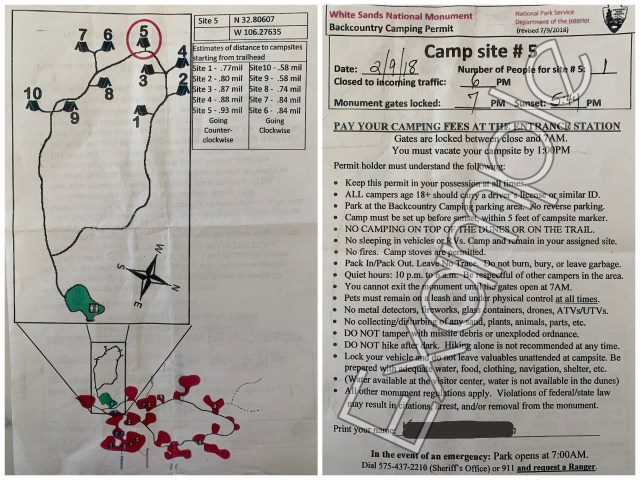
Camping at White Sands requires a permit. You cannot make a reservation or acquire a permit for a White Sands backcountry campsite until the morning of your overnight adventure. Verify hours of operation before you plan to arrive. Stop at the entrance fee station to obtain your permit.

Rangers assign the ten available camping spots on a first-come-first-served basis. Camping fees are $3.00 per person aged 16+ and $1.50 for those 15 and younger. You’ll pay this fee AND the general entrance fee of $25.00 per vehicle (waived if you have the national park pass) at the entrance station.

You must leave your site by 1:00 pm the next day, and you must request a new permit in person if you wish to stay another night.

​Poop: Your Dog and YOU

Yes, you have to scoop ALL the poop. Always practice the Leave No Trace principles. Check with a park ranger at the Visitor Center for a Wag Bag if you didn’t bring a waste disposal container. Or, as one crafty ranger recommended to me, you can use the bags they provide at the pet waste stations around the park (one of which happens to be located right in front of the visitor center). These pet waste bags are pretty large and sturdy, by poop bag standards, not skimpy ones that tear if you pick up more than one poop nugget.

Shop: These are the Earth Rated dog poop bags I use.

The Backcountry Camping Trail

You checked the weather, acquired a permit, loaded up on poop bags, took one last potty break at the toilets by the trailhead parking lot, and now you’re ready to head out on your adventure—woohoo!

The backcountry camping trail is a 2-mile lollipop loop that goes up, over, down, and around many dunes. With the ever-changing nature of the dunes, there is no regular trail on the ground you’ll follow. Instead, you follow orange trail markers staked into the dunes.

Once you reach your first marker on the trail, do not continue moving forward until you see the next marker. Continue this way for the remainder of the backcountry trail. Remember, you’re in a giant sandbox with no other landmarks to guide you, so it’s easy to become disoriented and lose track of your direction. Additionally, GPS tracks have a hard time displaying accurate readings out here. So, always stay aware of where the next trail or campsite maker is staked.

Campsites at White Sands

​You’ll eventually see the campsites noted on the trail markers as you’re cruising along the trail. Each campsite is in an open valley among the dunes. Once you find your campsite number on a trail marker, look for another marker at the base of the dunes. This is where you’ll set up camp, keeping your tent within five feet of that stake on the valley floor.

Camping With Dogs at White Sands National Park

ALWAYS keep your dog leashed while visiting White Sand National Park, even at the backcountry site. There are plenty of lizards and other animals around that you don’t want your dog to disturb. Additionally, you need to be able to find their poop to pack it out.

What to bring when camping with dogs at White Sands:

  • Water. There is NO water out in the dunes. Not even a stream. Make sure you bring plenty for yourself and your dog. Even if the temperature is cool, hiking across the dunes takes some effort.
  • Water bowl. Cool Whip and Hercules can drink out of my hydration pack spout, but a bowl is a lot easier. Here are some of the travel dog bowls we’ve used for hiking and backpacking.
  • Poop bags. Yes, I’m mentioning them again. Don’t be THAT person leaving poop around for others to stumble upon. Don’t bury it either. With all the wind blowing things around, it will resurface in no time.
  • Warm gear. The wind can cool you down a lot during the day, and it gets quite a bit cooler at night. Make sure your pup is comfortable. Bring a warm coat and a blanket or sleeping bag for your dog to snuggle into at night. Other than during our hike out to the campsite (mid-afternoon in February), Cool Whip and Hercules wore their fleece jackets the entire time.
  • Dog backpacks. These aren’t totally necessary, but they are helpful. Cool Whip and Hercules carried their own food and fleece sweaters. Herc is wearing the Ruffwear Approach Dog Backpack.

Now get on out there and have some fun!

Exit mobile version