Tettegouche State Park: Best North Shore Hikes and Camping

Venture up Lake Superior’s North Shore to visit Tettegouche State Park’s rocky cliffs, stunning waterfalls, and thick forests. Hikers, photographers, and nature lovers flock to this park for its pristine landscapes and outstanding views. I’ve stayed here several times to enjoy the park and as a home base while exploring more of the North Shore. Here’s my Tettegouche State Park guide to help you plan an extraordinary trip to this magnificent space.

A woman and two pit bulls are standing by pine trees at the end of a cliff in overlooking Lake Superior at Tettegouche State Park

This article contains affiliate links. I may earn a commission or revenue if you purchase an item through these links. This does not affect your price or savings. I appreciate your support!

Visiting Tettegouche State Park

Tettegouche, pronounced tet-uh-goosh, covers 9,300 acres of forests, cliffs, and rivers along Lake Superior’s shoreline. It’s rugged and wild and one of my favorite places on the North Shore.

Make the Tettegouche Visitor Center your first stop:

  • There is a lot of parking and great bathrooms if you need a break.
  • Stop by the coffee shop in the gift store to grab a latte, an ice cream cone, or a souvenir.
  • Check out the art and informational exhibits.
  • Sit by the fireplace or picnic areas for a cozy snack break.
  • Purchase a park pass (required to park in any MN state park)
  • Check in with a park ranger if you’re camping in the park.
  • Ask rangers any questions you may have before exploring the park.
  • Purchase firewood for a campfire at your campsite.
  • Walk down to the Lake Superior beach.
  • Pick up a Tettegouche trail map, then hit the trails!

The Tettegouche State Park office is open 9 am-4 pm daily. The park is open 8 am-10 pm daily.

Best Hikes at Tettegouche State Park

Tettegouche State Park has some of the best hikes in Minnesota. Trails vary in difficulty, from Shovel Point’s easy pathway to the brisk climb up to High Falls, the tallest waterfall in the park. Each of these northern Minnesota hikes welcomes leashed dogs!

Shovel Point

1.2 miles, out and back

Hike the Shovel Point Trail to kickstart your adventures around Tettegouche. You’ll set out from the visitor center and wind along the cliffs overlooking Lake Superior. From the platform at Shovel Point, you’re treated to outstanding scenic overlooks of Lake Superior and Palisade Head.

This is the first hike I do every time I visit the park. It’s also a great trail to stretch your legs if you’re traveling further up the North Shore for camping and lodging.

High Falls & Two-Step Falls

3 miles, out and back

Explore this trail to check out the tallest falls in Tettegouche State Park. You’ll hike up the eastern side of the Baptism River. Halfway up, you’ll take a staircase down to Two-Step Falls, and then, at the top, you’ll take a second staircase down to the base of High Falls. Try this as a sunrise hike to see the rising sun light up High Falls.

There used to be a bridge crossing over the top of the falls, but spring flooding in 2024 destroyed it. If you have time or are camping at the Baptism River Campground, visit the falls from the western side of the river.

A pit bull standing at the edge of the Baptism River with a view of High Falls in the background

Illgen Falls

0.8 miles, out and back

This 40-foot waterfall is located just off Highway 1. It’s about a half-mile upstream from High Falls. Near the start of your hike, you’ll pass a cabin you can reserve from the state park. This quick and easy hike is a great spot to escape crowds at the more popular locations.

Two-Step Falls via the Baptism River Campground

1.2 miles, out and back

This hike is excellent if you’re camping at the Baptism River Campground. The trail begins at the back of the campground loop. You’ll hike down 200 steps to reach the base of Two-Step Falls. From Two-Step, you can continue up the trail to the top of High Falls. I like to hike this trail with the dogs first thing in the morning when we’re camping here.

Looking up the pine tree-lined Baptism River to Two-Step Falls in Tettegouche State Park

Mount Trudee

6 miles, out and back

If you’re up for it, this challenging trek delivers an outstanding panorama from Mount Trudee. You’ll also get great views at the Red Pine Overlook and Raven Rock. Pick up your trail at the Superior Hiking Trail Trailhead near the Baptism River Campground. Pack plenty of water and snacks along with your other hiking essentials.

Tettegouche Lake

4.8 miles, lollipop loop

You’ll head to the park’s northern end for this underrated trail. The route loops around Tettegouche Lake with views of Lax Lake, Cedar Lake, and Floating Bog Bay. You’re more likely to have this trail to yourself than the ones that start near the visitor center.

Bean and Bear

7 miles, out and back

The Bean and Bear Lake Trail is a popular day hike along the Superior Hiking Trail on Tettegouche’s western side. Your destination is an overlook where the Bean Lake and Bear Lake line up one above the other. This hike will get your heart pumping, so prepare for a challenging day. Plan this adventure in the fall for a kaleidoscope of autumn colors.

Palisade Head

0.9 miles (winter), lollipop loop

This is less of a hike and more of a scenic overlook. You can drive up to the top in the summer. In the winter, you’ll have to hike up a short trail to reach the top. This is a fantastic North Shore photography location and a great spot to watch the sunrise or sunset.

View from Palisade Head, a tall cliff in Tettegouche State Park overlooking Lake Superior

Camping at Tettegouche State Park

This Minnesota state park has over 40 campsites spread throughout its thick forests. There’s sure to be one that suits your needs, whether you like to plug in your RV or prefer the more rustic options.

  • Baptism River Campground – 28 campsites with a mix of drive-in electric ($35/night), drive-in non-electric ($25/night), and walk-in ($25/night) options
  • Lake Superior Cart-In Campground – 13 campsites ($25/night) within 200 feet of the parking lot; use one of the provided carts to haul your gear to your site
  • Backcountry Camping – 5 campsites (first-come, first-served) along the Superior Hiking Trail
  • Cabins – 4 cabins at Tettegouche Camp ($130+/night) and 1 cabin at Illgen Falls ($220/night)

Note: Reserving campsites online also includes a $8 fee. All lodging options are reservable except for the backcountry campsites.

Tips For Reserving the Best Campsites

Check the site details and photos before reserving your campsite. Some sites have steep driveways, or you may have to climb a few steps to reach the picnic table and tent site. I’ve camped in the Baptism River Campground at sites 31E and 28. Site 31E was level with plenty of space around the picnic table area. Site 28 had a steep, paved driveway and an elevated firepit/camping space.

A view of the Baptism River as it flows between tall cliffs to Lake Superior in Tettegouche State Park

What to Pack for Hiking Tettegouche State Park and the North Shore

Check the weather before you head out adventuring and consider the following items:

  • Ten Essentials: Navigation, sun protection, insulation, illumination, first-aid supplies, fire, repair kit, nutrition, hydration, emergency shelter
  • Hiking boots: Lowa’s are my favorite for rough trails and damp conditions
  • Trail running shoes: Altra’s are my go-to for most hikes because they’re comfortable and lightweight
  • Long pants or leggings: Great for cool days and to help keep ticks at bay
  • Shorts: Running shorts are lightweight and dry fast during warm hikes or if you jump in a lake mid-hike (Stio’s Second Light series is my first choice – shorts and jackets)
  • Long-sleeve base layers: Consider a wool fabric for temperature regulation in both warm and cool temps and to protect yourself from the sun
  • Rain jacket: I keep a Stio Ender Rain Jacket in my pack at all times; it’s lightweight and packs up small
  • Bug repellent: Prep your gear beforehand with a permethrin spray and bring a spray or lotion for any exposed skin (Sawyer’s repellents are top-notch)
  • Binoculars: For wildlife watching and birding
  • Day hiking pack: Pick a hiking pack that’s large enough to hold your essentials and a few extra items (camera, binoculars, extra layers, etc.)

Add extra items like a puffy jacket and extra socks for shoulder season hikes and cool or damp days. If you’re heading out on a backpacking trip, don’t forget your tent, sleeping bag, and camp kitchen for a successful adventure.

A woman with a yellow hiking backpack is petting a gray pit bull on a rock outcropping overlooking a forested lake in northern Minnesota

Traveling and hiking with your pup? Check out our favorite gear:

Explore my RockPorch Gear Locker for all of my favorite camping and hiking items:

Explore the North Shore Beyond Tettegouche State Park

Expand your trip with these fantastic destinations along Lake Superior:

  • Gooseberry Falls State Park: Check out even more waterfalls at this popular park
  • Split Rock Lighthouse State Park: Visit one of the most photographed lighthouses in Minnesota
  • Temperance River State Park: Locate Hidden Falls, a waterfall tucked away in a narrow gorge
  • Gunflint Trail: Head up to Grand Marais and dive deeper into northern Minnesota’s backcountry on this scenic drive known for moose sightings and stunning hiking trails
  • Grand Portage State Park: The High Falls on the Pigeon River is the tallest waterfall in Minnesota
A woman and a pit bull are standing on a rock outcropping overlooking a marsh and forest with fall colors

Best Dog-Friendly Campgrounds in the Upper Peninsula, Michigan

Is there anything better than exploring and camping with your dog? Michigan’s Upper Peninsula (UP) holds a bounty of outstanding forests, rivers, and lakes worthy of such activities. To sustain such an adventure, you’ll need campsites that allow dogs. This article includes a few of the best dog-friendly campgrounds in the Upper Peninsula to consider. Plus, there are travel tips and gear recommendations to ensure you have a fun excursion with your furry pal.

A grey pit bull sprawled on a black and white rug alongside a campervan at a dog-friendly campground in the Upper Peninsula.

I may earn commission or revenue on some items through the links below. This does not affect your price or savings. I appreciate your support!

Is Michigan’s Upper Peninsula Dog-Friendly?

Most of the campgrounds and hiking trails around the UP welcome dogs. The area’s vast forests stretch between three of the Great Lakes—Lake Superior, Lake Michigan, and Lake Huron—and offer a host of opportunities for dog-friendly adventures.

Some areas in the UP, such as Kingsford and Bessemer Township, have breed-specific legislation (BSL) restricting or banning certain dog breeds. Pit Bulls, Mastiffs, German Shepherds, Rottweilers, and Doberman Pinschers are common victims of BSL restrictions. Always check the local regulations before you go. Most of the UP is dog-friendly.

A woman and a grey pit bull hiking in a pine forest in Michigan's Upper Peninsula

Best Dog-Friendly Campgrounds in the Upper Peninsula

With an exceptional spread of campgrounds across the UP, how do you know which ones are the best? Location ranks high. Cost and amenities are often top priorities as well. And, of course, campsites must be convenient and comfortable for your pup.

Here are a few of my favorite dog-friendly campsites in the Upper Peninsula.

Blind Sucker State Forest Campground: Hiking and Seclusion

Two Blind Sucker Campgrounds sit along the Blind Sucker Flooding shoreline: Blind Sucker #1 and Blind Sucker #2. They’re about 2.5 miles apart by car and connected by a short stretch of hiking trail. Lu and I stayed at Blind Sucker #1 Campground in August 2024. We were taking the scenic route from Tahquamenon Falls to Grand Marais and Pictured Rocks National Lakeshore.

Blind Sucker #1 includes two small loops, sites 1-6 at the first loop and sites 7-17 at the second loop. The first loop campsites offer little shade, but the second loop has plenty of trees providing shade and several of the sites are along the shoreline. Blind Sucker #2 features 4 loops with quite a few campsites along the water. Most of the sites here are shaded and many are quite spacious.

A campervan parked at campsite with trees and a sparse lawn

Why Blind Sucker is Great for Dogs

The Blind Sucker Campgrounds are excellent if you like solitude, hiking, or paddling with your pup.

  • The Blind Sucker Pathway connects to both campgrounds and Lake Superior if your dog likes to hike.
  • The Blind Sucker Flooding is a quiet spot to go paddleboarding for dogs who enjoy being on the water.
  • Lake Superior is also nearby if you both want to relax on the beach.
  • The Blind Sucker Campgrounds also offer plenty of campsites with shade to keep you and your canine pal cool on a hot summer day.

Blind Sucker State Forest Campground Details

  • 17 campsites, non-electric (#1)
  • 31 campsites, non-electric (#2)
  • First-come-first-served, no reservations
  • 15-day maximum
  • $20 per site

Amenities

  • Cell reception – Little to none (ATT)
  • Water – Hand pump, potable
  • Toilets – Vault
  • Showers – NO
  • Trash – Yes
  • Dump station – NO
A campground map for Blind Sucker Campground

Roads and Traffic Around Blind Sucker

You’ll have to drive down a long dirt road with some washboard patches to get here, but it’s worth it if you want to stay at a quiet, secluded campground. Quite a few OHV trails pass through the area, so expect some traffic if you’re out hiking or walking the roads.

The Lake Superior State Forest Campground is across the road (Grand Marais Truck Trail) on Lake Superior. These shaded campsites are very popular. When I visited, the entire Lake Superior State Forest Campground was full while there were only three campsites taken at Blind Sucker #1. It’s a beautiful camping spot though, with easy access to the sandy beach along Lake Superior.

Nearby Attractions and Day Trips

  • Lake Superior
  • Perry’s Landing
  • North Country Trail
  • Muskallonge Lake
  • Grand Marais
  • Pictured Rocks National Lakeshore
A small pit bull standing beside trail signs at a dog friendly campground in the Upper Peninsula

Little Bay De Noc Campground: A Lake Michigan Escape

This campground sprawls along the eastern side of Little Bay De Noc at the top of Green Bay. If you’re looking for a quiet site on Lake Michigan, the Little Bay De Noc Campground is a good one.

This Hiawatha National Forest campground was full during our stay but didn’t feel like it once we got settled. I drove in on a Thursday afternoon in August 2024 and snagged site 24, one of the last first-come first-served sites available. The sites near the water were closer together. This is where most of the big RVs were camped and running generators. The thick forest kept the sounds muffled though if you weren’t right next to them.

A campervan parked at a woodsy campsite at a dog friendly campground in Michigan's Upper Peninsula

Why Little Bay De Noc is Great for Dogs

Little Bay De Noc Campground has a few features that shine brighter than other dog-friendly campgrounds:

  • Many of the campsites are spacious to give your pup room to play.
  • Quite a few sites have enough trees between them to feel some sense of privacy and offer good shade.
  • There is dog-friendly beach access along the trail and boat ramp.
  • The trails and roadways are quiet if your pup loves to go for walks.

Little Bay De Noc Campground Details

  • 38 campsites, non-electric
  • Some sites are reservable at recreation.gov
  • Some sites are first-come-first-served
  • $24 single site, $48 double site
  • 14-day maximum
  • Two pets per site
A campground billboard noting leashes are required at this dog-friendly campground in the Upper Peninsula

Amenities

  • Cell reception – Moderate (ATT)
  • Water – Potable
  • Toilets – Vault
  • Showers – NO
  • Trash – Yes
  • Dump station – NO
A campground map for Little Bay De Noc

Roads and Traffic Near Little Bay De Noc

This campground feels like you’re out in the middle of nowhere but is easily accessible on a paved road. No sketchy switchbacks or muddy backroads to drag you down here!

Nearby Attractions and Day Trips

  • Hiawatha National Forest
  • Hunter’s Point Boat Launch
  • Big Bay de Noc
  • Escanaba
  • Hiawatha National Forest

Pete’s Lake Campground: A Dog-Friendly Site Near Pictured Rocks

Pete’s Lake Campground is parked right in the middle of the UP in the Hiawatha National Forest. We camped here in August to have close access to Munising and Pictured Rocks National Lakeshore. Pictured Rocks isn’t very dog-friendly, so this is a great spot to get away from the crowds and enjoy more freedom with your dog.

The campsites are spacious with the usual picnic tables and fire rings. Many sites have a good amount of forest between them for privacy. Some of the nicer sites cost more but might be worthwhile if you want a paved parking pad. While there was a decent vault toilet near our site (#3), some of the other toilets smelled so bad that you couldn’t walk by without getting a terrible whiff. It’s worth assessing the toilet closest to your site if you’ll be using it.

A campervan parked at a woodsy campsite at Pete's Lake, a dog friendly campground in the Upper Peninsula

Why Pete’s Lake is Great for Dogs

Pete’s Lake is beautiful and a big win for this location if your pup likes the water. Dogs aren’t allowed on the main beach, but they can get beach access by the boat launch and other paths leading to the shoreline. You also have direct access to Bruno’s Run, a long dog-friendly hiking trail winding around the surrounding lakes and through the forests.

Pete’s Lake Campground Details

  • 46 campsites, non-electric (+ walk-in sites)
  • Some sites are reservable at recreation.gov
  • Some sites are first-come-first-served
  • $24/$26 single site, $48/$52 double site
  • 14-day maximum
  • Two pets per site

Amenities

  • Cell reception – Moderate (ATT)
  • Water – Potable
  • Toilets – Vault
  • Showers – NO
  • Trash – Yes
  • Dump station – NO
A campground billboard with a campground map

Roads and Traffic Around Pete’s Lake

This is another spot that’s “out there” without the hassle of questionable roads. It’s paved all the way in, even through the campground. While a fair amount of people were recreating in the area, it was still a quiet space.

Nearby Attractions and Day Trips

  • Hiawatha National Forest
  • Bruno’s Run
  • Munising
  • Pictured Rocks National Lakeshore
  • Big Island Lake
  • Moccasin Lake

Glidden Lake State Forest Campground

We visited Glidden Lake Campground to access the Crystal Falls area. It’s a great alternative to Bewabic State Park if you want more solitude. Some of the sites are on the small side, but three of them are right on the shoreline. This small lake is the perfect setting to enjoy nature. Bring your paddleboard to float with your dog or go for a hike on the surrounding trails. There was no trash and the vault toilets were smelly, but the beautiful landscape was worth it.

A gravel campsite in front of a wooded lakeshore

Why Glidden Lake is Great for Dogs

Glidden Lake Campground is an ideal spot to camp with your dog if you like quiet spaces. Grab one of the campsites along the lakeshore for easy access to swimming with your pup or hopping on a paddleboard. There’s also a hiking trail that connects to the campground for a variety of dog-friendly hiking loops.

Glidden Lake Campground Details

  • 23 campsites, non-electric
  • First-come-first-served, no reservations
  • $20 per site
  • 15-day maximum

Amenities

  • Cell reception – Moderate (ATT)
  • Water – Hand pump, potable
  • Toilets – Vault
  • Showers – NO
  • Trash – NO
  • Dump station – NO
Sunset on a lake

Roads and Traffic Near Glidden Lake

Glidden Lake is another one of the easily accessible dog-friendly campgrounds in the Upper Peninsula. This site is close to town with a paved road leading up to the campground entrance. The campground roads are dirt but in good condition.

Nearby Attractions and Day Trips

  • Lake Mary Plains Pathway
  • Glidden Lake
  • Crystal Falls
  • Lake Mary

Michigan State Park Campgrounds

Do Michigan state parks have dog-friendly campgrounds in the Upper Peninsula? Yes, the state parks are a wonderful resource for dog-friendly travel and lodging. While I prefer the smaller state and national forest campgrounds, they don’t usually have showers or electric hookups. Camping at a state park for a night or two is a great way to recharge batteries and enjoy access to a hot shower.

I found the Michigan State Parks to be busy with more visitors, a lot of kids running around, and more dogs with less supervision. The sites felt cramped and often seemed like nothing more than a parking space on someone’s lawn, which looked like a muddy nightmare if you were visiting during a stretch of rainy weather. These sites weren’t the optimal environments for me as more than a one-night stopover, but I could imagine they’re excellent for families and anyone needing hookups. State parks offer many amenities that the state and national forest campgrounds don’t have the capacity to offer.

A woman and a pit bull on a paddleboard

Dog Gear and Tips for Your Upper Peninsula Camping Trip

You’ve picked your favorite hikes and mapped out the best dog-friendly campgrounds in the Upper Peninsula, but have you checked your dog’s camping gear? Here are a few of my favorite items to pack when traveling and camping with dogs:

Travel Water Bowl

Seems simple and obvious, but a well-designed water bowl makes traveling with a dog easier. In the van, a non-splash bowl keeps water contained. There’s no need to empty the bowl any time you’re on the move. There are no spills to wipe up once you stop.

Also, consider a bowl that packs down small. Kurgo’s Collaps-A-Bowl is incredibly convenient with its space-saving design to fold down flat. I use one of these for Lu’s food bowl. I fold it up and store it in the food container between meals (fewer crumbs and food smells to attract bugs/critters).

Food Storage

A secure storage bin keeps food contained and safe from rodents. There’s nothing more annoying than finding out a mouse snuck its way in to chew through the dog food bag for a midnight snack. I use the Vittles Vault to keep Lu’s food fresh and secure, and it’s easy to stow in the campervan.

Dog Harness

The best harness is the one that fits your pup. For Lu, I use Ruffwear’s Hi & Light Harness. It fits her meatball-shaped chest and is well constructed with strong but minimal materials. Lu dives into lakes, streams, and swamps as often as she can, so it’s nice having lightweight materials that don’t soak up much water or collect burrs. The lack of padding is also cooler on hot days and long hikes.

Waste Bags

Not much explanation is needed here. Pick up after your pet to keep trails and campgrounds clean for everyone to enjoy. I love the Earth Rated Waste Bags because they’re sturdy enough to handle a healthy-sized poop without worrying the bag will rip.

First Aid Kit

This is the most important item to have that you hope to never use. You can get a dog-specific first aid kit or you can add a few extra items to the one you (hopefully) already own. I use this weekend first aid kit I got from REI. I’ve added styptic powder, self-adhesive wrap (vet wrap), nail trimmers, antimicrobial spray, rubber dog boots, and a muzzle.

Don’t forget to check the expiration dates on medications and ointments in your kit. You can purchase replacement packs to refresh these items without having to buy a whole new first-aid kit.

Dog Bed

For the pups that love to sprawl and stretch out after a long day, the Kurgo Loft Bed claims the top spot in my book. It has a durable and waterproof bottom and a water-resistant top that makes it perfect for outdoor adventures. It rolls up small to help save space in your campervan or car.

Camp Chair

This falls into both the human and canine category. After a full day of exploring, there’s nothing better than settling down in a comfortable camp chair around the campfire. Kelty’s Low Loveseat is hands-down my favorite campsite item that’s a basic essential but feels like a luxury item. And perhaps most importantly, the low seat height makes it easy for dogs to climb up next to you.

A woman and dog cuddled up together on a loveseat camping chair

Conclusion: Dog-Friendly Travel is Easy and Fun in the UP

This is a small sampling of the many dog-friendly accommodations available across the UP but hopefully enough to inspire you to get out exploring with your best pal. Let us know if you have any camping, hiking, or gear recommendations of your own!

Van Life with Dogs: Tips and Gear for Life on the Road

A big part of van life is freedom, adventure, and creating memories. If you’re lucky enough, you’ll get to experience nomadic adventures with dogs by your side. Equipping yourself with the right dog gear for life on the road is important, whether you’re living in your van full-time or embarking on weekend trips. These tips and van life dog essentials will help keep your pup happy, safe, and comfortable as you explore new places together.

three dogs posed in the doorway of a van

I may earn commission or revenue on some items through the links below. This does not affect your price or savings. I appreciate your support!

Should You Get a Dog for Van Life?

If you don’t have a dog but are thinking about adopting one to join your van life adventures, there are a few things to think about first. A dog can be a wonderful companion on the road. They offer good company and a reason to get outside and explore. Some of my favorite adventures came about when I searched for places my dogs would enjoy! However, van life requires a great deal of flexibility, and you have to figure out if you can provide the care and attention a dog needs while living in a small, constantly moving space.

  • Puppies require extra attention, training, and socialization. This can be even more challenging on the road.
  • Do you have the time and resources to support your dog’s physical and mental well-being? Life on the road can involve unpredictable schedules and environments that may not always be dog-friendly.
  • Think about your dog’s temperament and health needs. Some dogs will thrive in a nomadic lifestyle, while others may struggle with the unpredictability and limited space.

Adopting a dog is a rewarding experience for the right person and dog. But it’s also a big responsibility that requires careful planning, commitment, and an understanding of what life on the road entails for both you and your furry pal.

A woman and two dogs hanging out at a campervan in the desert

Will Your Dog Enjoy a Nomadic Lifestyle?

Before heading out with your dog, consider how they might adapt to living in a mobile rig. Some dogs thrive on the adventure and new sights, sounds, and smells that come with constant travel. Others may struggle with the limited indoor space and unfamiliar environments. Dogs used to having a large yard to run around in or a predictable routine may need time to adjust to the smaller, more transient space of a van or RV.

Consider your dog’s temperament. Do they enjoy long car rides? What is their energy level? How do they react to new environments? Some dogs might find the constant change in scenery exciting and energizing, while others may feel stressed or anxious.

If your dog is adaptable, enjoys being with you no matter the setting, and is comfortable with being in tight quarters, they may love the flexibility of van life. However, if your dog tends to get car sick, is very territorial, or experiences separation anxiety, van life may require more patience and careful planning to ensure they feel safe and happy on the road.

FAQs About Life on the Road with Dogs

I got a lot of questions when people realized I lived in my van with two large dogs. Here are some of the most common questions that might help you build your van and plan for van life with dogs:

Where Do Your Dogs Sleep?

My dogs sleep on my bed. My bed is just a hair smaller than a queen. It’s a cozy fit with two humans and two 65-pound dogs.

I spread a blanket over my comforter for the dogs to lay on because blankets are easier to shake out and wash than comforters. A few other things to consider for your setup:

  • Do you want your dogs on your bed? Your van bed might not be as spacious as your regular bed, so it might be more comfortable for you or your dogs to have other options. There’s also the added dirt and hair that can accumulate with a pet on the bed. In the small space of a van, that adds up fast.
  • Do you have space to set up a separate sleep area/crate for your dog? At night, I used to set out one of the fluffier dog beds on the floor in case Cool Whip or Hercules wanted another sleeping option. During their van build, some dog owners include a dog crate or designated sleep space in the garage area under the bed. Maybe your dog curls up on the front seats or another seating area at night.
  • How will your dog get up and down? The higher your bed, the more challenging it is for your dog to get up there, especially a senior dog. My bed is fairly low (it’s a convertible dinette), but I still keep a stepstool in place to help my dogs get up and down. Step stools are helpful whether you have a large dog or small dog.
a white pit bull and a brown pit bull sitting on a pink comforter on a bed in a campervan.

What Does Your Dog Do While You Work?

My dogs were pretty good about sticking around the van while I worked. If I parked in a busy area, I’d keep them hooked to long leashes. This still gave them space to move from a dog bed to the grass, shade to sun, outside or inside. If there were a lot of distractions, I’d keep them inside to nap on the bed. A few things to consider with your van life dog:

  • How easily does your dog get distracted and will they run off or bark a lot? If they like to explore, consider a long leash to keep them close while you’re focused on work. If they like to bark at people passing by, try putting up your shades and keeping them entertained with toys or treats.
  • How will you keep your dog cool as the day warms? If you’re busy working, you don’t want to have to pack up and move. Look for dog-friendly camping spots with afternoon shade or somewhere you can catch a cool breeze. Learn the art of the cross draft if your furry companion stays inside. Turn on your roof vent fan and open the right combination of windows to get a good breeze flowing through the camper van. Invest in good fans. If you have AC, keep an eye on your power usage.
  • Will your dog nap most of the day or will they need entertainment? You may need to take your canine companion on more or longer walks if they have to stay near the van while you work. Bring toys or chews you can trust them with. Consider a post-work trip to a dog park or other dog-friendly places. Keep a list of dog-friendly activities on hand to ensure you have a happy dog while living vanlife.

What Do You Do with Your Dogs If You’re Visiting National Parks or Other Locations That Don’t Allow Dogs?

Dog-friendly van life is not always easy. There are still a lot of places that don’t welcome pets. My dogs are trustworthy enough to be left alone in the van, so running errands has always been easy. If it’s a hot day, I park in a shaded spot, turn on the fans, and try to be as efficient as possible. I also use pickup services at big box stores when they’re available. When it comes to hikes or destinations that don’t allow pets, I generally skip them.

There’s usually a nearby state park or public lands with equally epic (or better!) adventures that allow your dog to join in the fun. Bonus: These spots are often less crowded as well.

But there are other options to consider, such as leaving your dogs with a friend or family member or hiring a dog sitter on Rover. Even if pets are allowed at a national park campground, you cannot leave them unattended at your campsite or in your vehicle.

How Do You Keep Your Van Clean with All of the Sand, Mud, and Dog Hair?

There’s no way to get around it: there will be a lot of dirt and hair flying around your home on wheels. The trick with dogs in a van is to keep your space tidy and sweep it out often. Keep cleaning wipes and a hand broom easily accessible. I also have a small hand-held vacuum that is 100% worth the extra space it takes up. Spread a blanket across my bed so it’s easy to shake out dirt and hair the dogs bring up there. I have a small rug in my entryway and I put one outside at our campsites.

A brown pit bull and a white pit bull sitting on a dog bed by a campervan in the red desert of Utah.

Quick Tips for Van Life with Your Dog

Here are 10 van life tips with dogs:

  1. Keep a copy of your dogs’ vaccination records with you in the van. You may need these for border checkpoints or an emergency vet visit. Boarding facilities often require vaccination records as well.
  2. Look up your closest emergency vet each time you change locations, especially if you’re going to be in an area with poor cell reception. A big part of pet care while living in a van is planning for the times when you have limited resources. When Lu got too close to a porcupine in the middle of the Wisconsin woods, I didn’t have cell service, but I knew which direction to start driving to reach a vet (and got cell reception on the way to call ahead).
  3. Choose dog food that is easily accessible, and keep your pup on a regular eating schedule. You may need to stock up on dog food more than you did at home if your dog’s food is only available online or in a few locations. I wound up switching brands to one available at more stores rather than one I had to order online.
  4. Figure out how you’ll keep your dogs cool on a hot day. This may mean using fans, traveling to a cooler location, or installing an RV AC unit. I use rechargeable/USB-powered fans and open my windows to create a cross draft over the bed.
  5. Plan your travel days around your dog. Look up gas stations and rest stops with dog-friendly spaces, dog parks, or dog-friendly hikes you can do along the way.
  6. Opt for dispersed camping if your pups need fewer distractions and more freedom. Apps like iOverlander, Sekr, or Campendium help find campsites while you travel.
  7. Use bedding and blankets that are easy to clean, especially if your dog sleeps on your bed. Everything seems to get dirty faster when living out of a van. I put a blanket on top of my comforter that is easy to wash more often.
  8. Get a small broom or hand-held vacuum to keep dog hair and dirt under control. I have a Shark hand-vac that makes cleaning up incredibly easy.
  9. Get good gear for your walks – leash, treat pouch, and poop bag dispenser. Surprisingly, it’s easy to lose stuff in this small space, so having a setup ready to go makes a world of a difference.
  10. Put your van keys on a carabiner clip. It’s easy to attach to a belt loop, purse strap, leash, backpack, etc. One less thing to lose while running around with your pups!

Van Life with Dogs: Gear Recommendations

A lot of the dog gear you use now will work great for living van life with dogs. Start with what you have while you’re figuring out what might work best for your particular setup. If you’ve already been on a road trip with your dog, you’ll probably have most of this gear. Here are some of my favorite items my dogs and I have used while living on the road:

Dog Travel Bed or Blanket

Van life dog travel means having a cozy, portable dog bed or blanket for your pet’s comfort during travel and rest. A bed with a durable, water-resistant bottom or a blanket that can double as a cover for your dog’s resting area is ideal.

I keep both in my camper van. I have one extra-soft blanket where Lu likes to sleep, and then I spread another across the bed. It’s cozy for Lu and helps keep the rest of my bedding clean. It’s easier to clean or shake out a blanket than my whole comforter. I also keep at least one travel dog bed in the van with a tough, water-resistant bottom that I can set anywhere on the ground without worry.

What to Look For:

  • Compact and easy to store
  • Waterproof or water-resistant features for varying conditions
  • Easy to clean

Recommendation:

  • Kurgo Loft Bed – Waterproof (bottom) and portable, this bed is perfect for van life
  • Stio + HEST – A great, cushioned option that’s easy to store. Water-resistant
a camper van parked near the forest with a camp chair, dog bed, and two dogs.

Collapsible Food & Water Bowls

Storage space is limited in a van, so collapsible bowls are essential for feeding your dog on the go. They’re compact, easy to pack, and can be used both in the van and during extra adventures for meals.

I use a collapsible bowl for Lu’s food so I can fold it down and store it in the food canister (one less thing out and about to attract pests). I use a splash-free bowl for water so it never spills out onto the floor, even during travel—legit one of the best things I keep in the van.

What to Look For:

  • Easy to store and clean
  • Lightweight and portable

Recommendation:

Three travel dogs bowls

Dog Food and Treat Storage

You need an efficient and space-saving storage for your dog’s food and treats. Consider investing in airtight, portable containers to keep their food fresh and free from pests (mice are a legit threat!). Lu’s kibble gets stored in a Vittles Vault that fits under the bed. I store her snacks, supplements, and accessories in a small, plastic storage bin that fits in one of the cabinets.

What to Look For:

  • Airtight storage that keeps food fresh
  • Compact, stackable containers

Recommendation:

Dog Harness & Seatbelt or Crate

For any road travel, a dog seatbelt harness or crate is important for safety. It helps prevent injury in the event of sudden stops and keeps your dog secure.

What to Look For:

  • A comfortable harness that doesn’t restrict movement
  • Easy to attach to seatbelts or van seat anchor points
  • A crate that’s ventilated for airflow, durable, and comfortable for your dog

Recommendation:

Dog Waste Bags and Dispensers

You’ll need to clean up after your dog. It’s simply part of having a pet, even a van life dog. Consider a portable dog waste bag dispenser that attaches to your dog’s leash or your backpack. I’m obsessed with Muttruk products, especially the Sidekick Hip Pack. It has a waste bag dispenser, a snack pocket, plus two other pockets where I keep my wallet so I only have to grab one item when I step out of the van and we’re good to go.

What to Look For:

  • Convenient, hands-free access to bags
  • Durable dispenser that can be attached to leashes, backpacks, or vans

Recommendation:

A small gray dog and a woman are walking through a field of tall grass with pine trees ahead.

Dog First Aid Kit

When traveling or living in a camper van, it’s important to be prepared for emergencies. A dog first aid kit is a great item to have on hand for minor injuries, illness, or other health-related issues. If you already have a human first aid kit, just add a few extra items like wound care spray for pets, vet wrap, and a muzzle.

When you’re traveling through new spaces, you don’t always know what the terrain or potential hazards might be. All it takes is one cut paw pad to suddenly have blood polka-dotting your van floors and bedding.

What to Look For:

  • Compact and easy to store
  • Contains key supplies like bandages, antiseptics, and tweezers

Recommendation:

essential safety items for van life with dogs: a group of pet snack, pet wound care spray, dog nail trimmers, vet wrap, a muzzle, and a first aid kit

Dog Leash and Long Line for Van Life with Dogs

When you’re out exploring the great outdoors or on the road, your dog will need a reliable leash or a longer line to give them some freedom while staying safe. Not all dogs are great at staying close—and that’s okay! A long leash is perfect for allowing your dog to roam in open spaces without worrying that they might run off to chase a new scent. Long lines are also helpful when you have to work but you want to let your furry friend have the freedom to hop in and out of the van at will. If you’re in a campground, check the leash restrictions. Most require pets to be on leashes of 6 feet or less.

What to Look For:

  • A durable, tangle-free leash
  • A long leash that allows freedom of movement but keeps your dog under control

Recommendation:

Dog GPS Tracker

Having a dog GPS tracker is an excellent safety measure when you’re traveling, especially in unfamiliar places or outdoor environments. It can help you locate your dog quickly if they wander off during a hike or exploration.

What to Look For:

  • Real-time tracking and long battery life
  • Waterproof and durable

Recommendation:

A white pit bull wearing an orange bandana and a rainbow colored GPS tracker standing in a grassy meadow among trees

Magnetic Screen Doors for Van Life with Pets

If you’re traveling in an area with flies, mosquitos, or any other flying insect, screen doors are a must. There are screens made specifically for van doors. My dogs jump in and out at will, so I don’t want to have to zip or slide open the door every time. I love the simple and inexpensive screen cover for regular doors.

What to Look For:

  • A size as large or slightly larger than your door opening
  • Magnetic closure that will line up with the center of your door opening

Recommendation:

Kelty Low Loveseat Camp Chair

There’s enough space to fit you and a dog (or two if you get the couch size). Plus, it’s low and easy for a dog to get into without flipping over. All of my dogs have loved this chair! Worth the extra space it takes up.

What to Look For:

  • Kelty. There might be other brands offering similar chairs, but this one has survived several years of van life and multiple dogs. It’s the only one I’ll recommend.

Recommendation:

A pit bull and a woman sitting in camp chair next to a campervan and a campfire ring.

Conclusion: Enjoy Van Life with Your Dog

Whether you’re hitting the open road or cozying up in a campsite, the right gear will ensure your dog is as comfortable and safe as possible, making every trip together unforgettable. Start with what you have available and add to your setup as you and your dog settle into van life. Pet-friendly van life can take some extra planning, but it is worth it.

Let us know your must-haves for van life with dogs!

Best Dog Bowls for Hiking and Road Trips

Dog bowls – the first thing I pack for any road trip. Finding the best travel dog bowl for hiking and road trips can make all the difference in your adventure. Whether you’re hitting the trails or taking a road trip, having the right portable bowl is key to your dog’s comfort and hydration. Here are a few notes to help you choose the best bowl, plus some of the best dog bowls for hiking and travel that work for us. 

A brown dog drinking out of a red fabric dog bowl for travel and hiking
MuttRuk RollOut Travel Bowl

I may earn a commission or revenue on some items through the links below. This does not affect your price or savings. I appreciate your support!

Types of Portable Dog Bowls for Travel and Hiking

What makes the best travel dog bowl can vary for each dog owner and canine company, but here are some dog bowl types to consider:

  • Foldable Dog Bowls: These bowls typically have a fabric exterior and a waterproof or water-resistant interior, making them both durable and lightweight.
  • Collapsible Dog Bowls: These bowls, typically silicone, are space-saving and portable, perfect for outdoor activities.
  • Fixed-Form Silicone Dog Bowls: These dog bowls are sturdy and can stand up to extended use. While they don’t collapse, they are great for longer trips or when your dog needs a full-sized bowl.
  • Fixed-form Plastic, Ceramic, or Stainless Steel Bowls: These are the regular non-collapsible bowls you might use at home. I have ceramic bowls and stainless steel bowls for Lu at home. Consider them for stationary trips like car camping, van life, or long road trips.

What to Look for in the Best Dog Bowls for Travel and Hiking

At home, most dog guardians (myself included) use ceramic or metal bowls. And these are great for the stationary home. But they’re heavy and bulky to fit in a backpack for a dog-friendly hike. Less is more for travel as well. That’s where the dog bowls designed for travel come into play.

What to look for in the best portable dog bowl:

  • Collapsibility: A dog bowl that will collapse or fold down to a smaller size saves space in your backpack or car. More room for snacks!
  • Weight: If you’re a backpacker or hiker, you don’t want a heavy bowl in your backpack or your dog’s backpack. This is where the fabric bowls win as an ultralight dog bowl, without a doubt. But the collapsible silicone bowls are still fairly lightweight and a great option for road trips and more.
  • Waterproof or Water Resistant: Not all travel dog bowls are meant for water. And for those that are, some are more waterproof than others. Many fabric bowls are only intended for a quick drink on the go, and they may only be water-resistant. If you’re camping, you will want something that can hold water all day.
  • Capacity: How much water does the bowl need to hold? Small dogs drink less than large dogs. Whoa, what?! Yeah, wild, I know. 
  • Durable: Many of the collapsible dog bowls are made of silicone, which is quite durable. But also consider any other materials used, such as a plastic top edge that could crack or break over time. And don’t discount those fabric bowls in this category! Most foldable, fabric-type bowls use a 600-denier fabric, which is durable enough to stand up to your backcountry treks or inner-city strolls.

​What is Denier? It’s a unit of measurement used to determine the fiber thickness of individual threads used in the creation of fabrics. Fabrics with a high denier count are thicker and more durable. Those with a low denier count are softer and silkier.

A collection of various styles of travel dog bowls.

​Best Foldable Dog Bowls for Hiking

​These are the most compact and packable dog bowls for hiking. Ultralight dog bowls are typically made of a 600-denier polyester outer layer and a waterproof interior.

MuttRuk: RollOut Travel Bowl

Price: $20 at muttruk.com

Features: Waterproof, collapsible, includes a carabiner for easy attachment, and rolls up for easy storage

Best For: Quick access during hikes and adventures

This is my current go-to dog travel bowl for outdoor adventures (I have it in two colors!). MuttRuk has thought of everything for this bowl: flexible, durable, waterproof material that rolls up and secures with a snap; plus, a small carabiner to hook the bowl right to your dog water bottle or the side of your pack, leash, etc. You don’t even have to take off your backpack to access the bowl—unclip it, unroll it, and fill it with water from your hydration pack. It is a great option for pet parents with a small or large dog.

Ruffwear: Quencher

Price: $20 at ruffwear.com

Features: Durable fabric, water-resistant, folds easily, loop for carabiner attachment.

Best For: Lightweight, short hikes, and city strolls.

I received the small version of the Ruffwear Quencher in an outdoors subscription box several years ago. It was a great win back then and still is. Packable and durable. It also has a loop to attach a carabiner. 

(Note: The Outward Hound bowl pictured below is no longer available.)

Three foldable travel dog bowls in pink, blue, and gray.
A white dog drinking from a red foldable travel dog bowl
MuttRuk RollOut Travel Bowl
A while dog drinking from a pink Ruffwear travel dog bowl
Ruffwear Quencher Travel Bowl

Top Collapsible Dog Bowls for Travel

These dog bowls collapse flat. They aren’t quite as compact and light as the foldable bowls, but they are sturdier. I prefer these when I know we’ll have a home base, such as when we’re camping or on a road trip. You can leave the bowl full of water all day, and it won’t leak.

Kurgo: Collapse A Bowl

Price: $13 at kurgo.com

Features: Collapsible, comes with a carabiner, easy to store

Best For: Road trips and outdoor adventures

I love this bowl and have it in three colors! I leave one in the car for emergency water needs and use the other two during road trips. Because they collapse down flat, they fit right in the dog food container without taking up any extra space. I like the Kurgo Collapse A Bowl as a dog food bowl because it’s easy to clean. Plus, they have small carabiners to attach to a backpack if you take them hiking, etc. 

Ruffwear: Bivy Collapsible Dog Bowl

Price: $30 at ruffwear.com

Features: Durable fabric, water-resistant, folds easily, lightweight

Best For: Short hikes and city strolls

I don’t remember how I wound up with this bowl (I think in another subscription box), but it was my first introduction to a collapsible dog bowl not made of silicone. What’s important about that? It weighs a lot less, another great ultralight dog bowl option. The wide base of this bowl keeps it stable. This is helpful as pups are running around, or with enthusiastic eaters, when used as a dog food bowl.

Three collapsible dogs bowls for travel and hiking
Kurgo Collapse A Bowl on the left, Ruffwear Bivy Collapsible Bowl on the right

​Best Silicone Dog Bowls (Fixed Form)

Not the type of bowl you’d toss into your backpack for a hike, but a fixed-form silicone bowl is perfect for road trips and extended camping adventures. The collapsible bowls are durable, but my dogs inadvertently collapse them partway if I leave the bowls out unattended. This is where a fixed-form bowl comes in handy: hotels, campsites, in the car, etc. 

Sleepy Pod: Yummy Travel Bowl

Price: $36 at sleepypod.com

Features: No-spill, durable design, interlocking bowls for food and water

Best For: Extended trips like camping, road trips

I received this bowl set in a gift bag at a car-safety event. Legit the best thing I’ve ever received in a gift bag! It doesn’t pack down smaller, but it is still well-designed for travel. The inner bowl was too small to use as a food bowl for Cool Whip and Hercules, but it would be perfect for a small dog. The no-spill water bowl is a significant upgrade for road trips. Bonus: I accidentally ran it over once and didn’t do a bit of damage.

Kurgo: Splash-Free Wander Dog Water Bowl

Price: $14 at kurgo.com

Features: No-spill, durable design, less expensive

Best For: Extended camping and road trips

If you don’t need the interlocking food bowls, this no-splash water bowl from Kurgo could be a great alternative. One significant difference with this bowl is its angled design. The base is wedge-shaped so you can set it on the car seat and the water will still sit level for easy drinking. Note: I have not tried Kurgo’s no-splash bowl.

A 3-piece set of silicon travel dog bowls
Sleepy Pod Yummy Travel Dog Bowl
A silicon dog bowl survives being run over!

How to Choose the Right Dog Bowl for Your Trip

The type of bowl you choose should depend on various factors, including your dog’s size, the nature of your trip, the weather conditions, and the balance between portability and durability.

Consider Your Dog’s Needs

Some dogs may require more hydration than others, especially during strenuous hikes. If you know your dog tends to drink more often or during exercise, opt for a larger or deeper bowl. Additionally, if your dog is prone to drinking rapidly, look for a non-spill bowl to avoid making a mess.

For small dogs, a compact, collapsible bowl will usually suffice. Larger dogs will likely need a bowl with more capacity. Durability and stability also become more important for larger dogs, so consider a sturdier material.

Type of Adventure

The type of adventure you’re embarking on can greatly influence the best dog bowl for the job. Whether it’s a quick day hike or an extended camping trip, the right bowl will differ based on the trip’s duration, location, and accessibility.

  • Backpacking or Multi-Day Hikes: For backpacking trips where you’re trekking with your dog for several days, a collapsible bowl is usually the best option, as it can be rolled or folded up to save space. However, you may also want to bring a more durable bowl for meal times, especially if you’re in an area with limited water sources. Bowls that roll up work great for space-saving and can handle outdoor wear and tear.
  • Short Day Hikes or Quick Trips: If you’re going on a short hike, a collapsible or foldable bowl is typically the best option. These bowls are compact, lightweight, and easy to pack, making them perfect for short excursions. They can be stowed away in your backpack or clipped to your gear when not in use. Collapsible bowls are great for dogs that don’t need a large amount of water or food throughout the day.
  • Weekend or Extended Camping Trips: For longer trips like camping, durability and capacity become more important. You might need to choose a fixed-form bowl or silicone bowl that can hold more water and withstand longer use. If you’re planning to leave water out for your dog all day, a bowl that doesn’t collapse and offers a spill-resistant design is essential. Silicone bowls tend to perform well for this because they are stable and won’t collapse under pressure, even when your dog drinks or eats from them multiple times a day.

Portability vs. Durability

When choosing the best travel dog bowl, you’ll need to weigh the trade-offs between portability (how easy it is to pack and carry) and durability (how well the bowl can withstand extended use in rugged environments). Both aspects are essential, but the right balance depends on the nature of your trip.

  • Portability: If you’re hiking with limited space, a collapsible or foldable bowl is the best option. These bowls are designed to fold down to a fraction of their size, which is perfect for minimizing bulk in your bag. Collapsible bowls made from silicone or fabric are lightweight, making them a top choice for lightweight travelers. They often come with clips or carabiners to attach them to your backpack when not in use.
  • Durability: If your trip involves rough terrain, multiple dogs, or prolonged use, durability should be your priority. Silicone bowls are often the most durable for regular use, as they won’t collapse over time and can withstand heavy usage. Fixed-form bowls made from stainless steel or rigid plastic are often the most durable. However, this type is not as space-saving as collapsible bowls and does not make the best travel dog bowl.

By balancing portability and durability, considering your dog’s hydration needs, and matching the bowl to the nature of your trip, you can ensure that both you and your dog get to enjoy the adventure!

Have you tried any of these travel dog bowls? Let us know what you think makes for the best travel dog bowl in the comments, and don’t forget to check out our other pet travel guides!

Backpacking with Dogs: What to Pack

Thinking about backpacking with dogs? Whether it’s your first trip or your tenth, consider these items and tips to help you pack for a successful trip with your pups!

10 Items to Pack for a Backpacking Trip with Your Dog

We all have slightly different setups for our backpacking gear essentials, including those we put together for our dogs. Here are ten essentials I consider including when I go backpacking with my dogs.

I may earn a commission or revenue on some items through the links below. This does not affect your price or savings. I appreciate your support!

1. Dog Backpack

Outfitting your dog with a backpack can give them a sense of having a job to do. They can carry their essentials like food, water, and gear. These are two of my favorite dog backpacks that Cool Whip and Hercules actually used:

Tips for Picking the Right Backpack for Your Dog

There is no one best dog backpack; it’s about what works best for your dog.

  • Measure your dog. Don’t rely on weight estimates to select a backpack for your furry friend. Measure the largest part of their chest as you would for a regular harness. A well-fitting and comfortable backpack helps your dog have a more enjoyable backpacking adventure.
  • Check the saddlebag size. Think about the length of your trip. A longer trip requires more food and possibly more gear. Make sure the saddlebags can fit everything your dog might be carrying.
  • Weigh your dog’s backpack. How much can a dog carry in a backpack? Your dog should only carry 10-15% of their body weight. Extra large saddlebags aren’t always that necessary.
  • Start with a day hike. If your pup is new to backpacking, start with a short day hike. Practice hiking in the pack without weight to test the fit. Slowly add weight for a few hikes to build their stamina and strength.
A brown pit bull wearing an orange dog backpack standing on a rocky mountainside

2. Leash, Collar, Harness

Always bring a leash (6 feet or less, not a retractable leash), even if you’re on a hiking trail that doesn’t require your dog to be leashed. You may encounter another dog or other animal along your hike that makes your dog nervous and you’ll want to keep them close. Your dog may also encounter a wild animal it wants to chase, which is not safe for you, your dog, or the other animal(s).

A collar is great to have to carry your dog’s ID tags. It’s also a good backup attachment point for when you need to remove your dog’s backpack or if the backpack malfunctions. 

If your pup isn’t wearing a backpack, a regular dog harness with a handle along the back is a good idea for an outdoor adventure. I love Ruffwear’s Flagline Harness. The handle is useful for helping your dog (especially an older dog) up or down challenging steps and rocky climbs, crossing streams, and more. 

A white pit bull standing on a rocky ledge in front of a river with greenery, rocky cliffs, and sunrise colored clouds in the background

3. Water Bowls and Water

It is always important to carry sufficient water for your dogs and a bowl for them to drink from. Collapsible bowls are my favorite to carry on our outdoor adventures. They’re typically lightweight and collapse down to take up minimal room in your back.

Related Article: Best Dog Bowls for Hiking and Road Trips

A white dog drinking from a red foldable travel dog bowl

4. Dog Food, Food Bowls, Treats, and How to Pack Them

There are a lot of factors to consider when packing dog food for a backpacking trip with dogs. Here are some of the most common questions:

How much dog food should you pack for a backpacking trip with dogs?

Pack enough dog food for the duration of your trip, plus an extra day in case of emergencies. Give your dog larger portions than they get at home since they’re likely expending more energy. 

Also, don’t forget to bring their favorite dog treats for rewards and encouragement.

What type of dog food should you pack when backpacking with your dog?

Dehydrated or freeze-dried dog food is a great choice for packing light. However, you’ll need to ensure you have enough water to rehydrate their food. If you’re backpacking in an area without access to water, you’ll have to carry that water in, which means more weight in your pack. 

Packing dry kibble weighs a little more, but it’s easy to pack and serve. Packing raw dog food can be the most challenging if you need to keep the food cold for multiple meals. Also, it may weigh the most.

Ultimately, this may depend on what your dog eats at home and what they’ll be willing to eat in the backcountry. Hercules used to get nervous in new environments and wouldn’t eat his regular dog kibble for the first meal or two. I would have to bring more enticing food to keep him nourished and energized.

Consider making your first backpacking trip with your dogs a short, easy trip so you can pack extra options to figure out what works (for food and other items). This makes it easier to head home if the trip goes wildly awry.

How should you pack dog food for a backpacking trip?

Packing your dog’s food in a hard-sided container may seem like the most secure option, but it can be challenging to fit into a backpack. 

Some companies offer soft-sided kibble carriers, which are easier to fit in a backpack (yours or your dog’s). The challenge with these can be volume: Will it hold enough food for your dog(s)? When I was backpacking with Cool Whip (70 pounds) and Hercules (65 pounds), I couldn’t find any soft-sided kibble carriers that could hold the quantity of food they needed for more than a day or two.

I typically pack dry kibble for my dog backpacking trips. I put 1-2 servings of dog food in a sandwich-sized resealable plastic bag. Then I put each day’s servings in a quart or gallon resealable plastic bag. 

Two pit bulls in warm jackets and hiking gear looking ahead at the sun peeking around a red sandstone cliff

Do you have to pack dog food in a bear-safe container?

If you need a bear canister for your food, you must include your dog’s food in there as well. Check the bear-safe regulations for the area where you’ll be hiking. Certain national forest, state park, or national park organizations might require bear-safe food storage:

  • Bear-safe canisters
  • Bear boxes at campsites
  • Hard-sided vehicles
  • Hanging food at least 10 feet off the ground and 4 feet away from branches and tree trunks

5. GPS Dog Tracker and Identification

Make sure your dogs are wearing ID tags with your contact information. Also, consider investing in a dog GPS tracker. Most GPS dog trackers require a subscription, so it’s a good idea to set this up well before your hiking trip to ensure it’s active and you know how to use the app to locate your dog.

My two favorite dog GPS trackers for Cool Whip, Hercules, Lulu, and my parent’s dog Phyllis are from Tractive and Whistle (both purchased in Spring 2022). The original Whistle device I use (Go Explore) is no longer available, but there is a 2.0 version (I do not know if it works as well or better). I also tried the Fi tracker, but it didn’t work well in my area (limited cell reception).

A white pit bull wearing an orange bandana and a rainbow colored GPS tracker standing in a grassy meadow among trees

6. First Aid Kit for Dogs and Carry-Out Harness

A lot of the items in your regular first aid kit can be useful for your furry friend, but there are a few additional items you’ll want to consider adding. Check with your vet to review what is safe for your dog and when/how to use each item. 

  • Safety carry-out harness – Carry out your dog if they’re unable to walk
  • Rubber dog boots – Keep an injured paw clean and dry
  • Self-adhering bandage – Wrap up a wound without tape that sticks to fur
  • Antibiotic spray/ointment – Healing aid and protection
  • Digital thermometer – Easy to read
  • Muzzle – For your safety and theirs
  • Slip lead – A backup leash that doesn’t require a collar
  • Benadryl – For allergies
  • Irrigation syringe – Helpful in giving oral medication or flushing wounds
  • Milk of magnesia / activated charcoal – Absorb and counteract poisons
  • Hydrogen peroxide – Antiseptic
  • Non-medicated saline rinse – Flush wounds and eyes
  • Styptic powder – Stop bleeding from a torn nail
  • Magnifying glass – Easier to see splinters/wounds
  • Needle-nose pliers/multi-tool – Remove thorns, etc.
  • Tick removal tool
  • Disposable gloves
  • Flashlight
  • Pet first aid book

7. Poop Bags

Good trail etiquette for any dog owner is to pick up after their pet. Carry enough poop bags to clean up the dog poop your pup leaves along the hiking trail. The easiest way to get dogs banned from a dog friendly trail is to leave dog poop on the trail for other hikers to encounter.

8. Weather Protection When Backpacking with Dogs

Check the weather before your hike and pack accordingly for your canine companion: rain jacket, dog fleece coat, insulated dog jacket, dog booties, etc. At minimum, I include our Tooth and Honey fleece jackets (lightweight but warm) for the dogs. Even on a warm day, we can all get chilled as the temperature drops in the evening.

Two pit bulls in blue fleece sweaters looking out a field of large stone pillars while camping at City of Rocks State Park NM

9. Sleeping Gear for Dogs Backpacking

Where will your dog sleep at night? If you have a medium or small dog, they might sleep in your sleeping bag. For Cool Whip and Hercules, I would bring my Klymit inflatable sleeping pad and a fleece blanket for them to sleep on (the blanket kept the pups cozy and protected the pad from their nails). Another option might be to bring a lightweight dog bed or foam sleeping pad (cut in half if they don’t need the full length).

A white pit bull sleeping on a green sleeping pad in a tent

10. Backpacking Tents

I did most of my backpacking with two large dogs, so I needed a tent that accommodated more than one person. I opted for a two-person backpacking tent. Backpacking tents can be slightly smaller than the average tent, so a three-person backpacking tent might be worth considering as well. The extra space was worth a bit of extra weight. When car camping, a regular two-person tent fit us just fine.

Additional Considerations When Backpacking with Your Dog

Protect Your Tent Floor

When camping in soft or sandy areas, there is a chance your dog’s nails will puncture the tent floor (speaking from experience). Before I let the dogs in the tent, I spread out a blanket or put down the sleeping pads and sleeping bags right away.

Add tent tape to your emergency pack. Seal holes when you find them to prevent additional ripping or leaks.

Protect Your Dog’s Paws

Dog boots are a great way to protect your dog’s paws. Not all pups are used to walking on rough terrain or for a long distance. I also keep a set of rubber booties in the first aid kit. They’ll keep paws clean and dry in the event of a cut paw or abrasion.

What other dog gear do you include in your pack when backpacking with dogs?

Top Dog Road Trip Essentials: Must-Have Gear for Traveling with Your Dog

Preparing for your first (or any!) road trip with your dog is exciting. As you consider what you might need, it can feel like you’re packing your whole house and there’s no way it will all fit in your car. So, what are the dog gear must-haves for your dog-friendly road trip?

Top 10 Must-Have Dog Road Trip Essentials for a Smooth Journey

I may earn commission or revenue on some items through the links below. This does not affect your price or savings. I appreciate your support!

When you’re hitting the road with your dog, packing the right gear is essential for a stress-free and enjoyable trip. These dog road trip essentials will help you stay prepared and keep your pup comfortable throughout the journey.

1. No-Splash Water Bowl

A no-splash water bowl is a must-have for every road trip with your dog. It ensures your dog always has water without making a mess. Whether you’re driving cross-country or on a weekend getaway, this bowl keeps things tidy and convenient.

In the van, I leave this on the floor and there’s never been an issue with spilled water. I’ve perched it on the center console or in the back if I have the backseat folded down. I feel so much better knowing the hounds have access to water whenever they’re thirsty.

What I use: Kurgo No Spill Water Bowl

2. Collapsible Food Bowl

Save space without compromising on your dog’s meals. A collapsible food bowl can be easily packed into your dog’s food container or a small bag, making it the perfect travel companion. Keep your regular food dishes off your packing list.

What I use: Kurgo Collaps-A-Bowl

3. Food Canister

I love the Vittles Vault pet food storage containers. They’re durable and secure. Skip the risk of ripped bags or a basic storage box the dogs can break into (trust me, I’ve dealt with both). I have a full-sized one at home for the main food storage and a smaller one I use for road trips.

If you don’t fill the entire container, it’s also a great place to stash your bags of dog treats. Keeping all of the food items contained also makes your space less enticing for critters like mice.

What I use: Vittles Vault – Dog Food Storage Container

4. GPS Tracker

Including a dog GPS tracker in your rod trip essentials is a great idea for ensuring your dog’s safety, especially during stops in unfamiliar places. These small, lightweight devices allow you to track your pup’s location in real time, which is incredibly helpful if they get separated while exploring new areas. Herc and Cool Whip each had a GPD tracker and now Lu does as well. Lu currently wears a Tractive device, but there are a variety of quality options available depending on your needs.

What Are The Best GPS Dog Trackers For Your Pet?

A gray and tan pit bull stands on a rock outcropping in front of a river with pines in the background.

5. Poop Bags

Make sure you bring more than one poop bag because your pup will need a potty break and you’re a responsible pet parent. A lot of dog-friendly places have waste bag dispensers nowadays, but they run out fast. I try to keep a couple of rolls of waste bags in my glove compartment at all times.

What I use: Earth Rated Waste Bags

6. Car Seat Cover

When the dogs ride in the back seat of the car, a seat hammock contains the dirt, hair, water, etc. I like the hammock version because it keeps them from falling in the footwells. It also has openings for seat belt clips for a safe car ride. This is in my car at all times but is easy to pack up as needed.

What I use: Kurgo Seat Hammock

Bonus Tip: Consider getting a car safety harness and dog seat belt that clips into the regular seat belts. Extra safety is always a good idea.

7. Travel Dog Bed

Comfort is key when going on a road trip with your dog. Look for a dog bed with a durable bottom that won’t rip and repels water. I love Kurgo’s Loft Beds. They have a tough, waterproof bottom, so I don’t hesitate to set them down anywhere during our pit stops and camp-outs.

What I use: Kurgo Waterproof Dog Bed

8. Long Leash

Give your furry friend a little freedom even if they need to be leashed. These are great for letting the dogs have some space while I set up camp and can’t keep a close eye on them.

Bonus: Carabiners. These are gold in my eyes. I bring at least four on each trip. Connect your dog leash to anything to keep your hands free to unpack, make lunch at a rest stop, etc. They’re also great for setting up a dog zip line for a bit more freedom during a camping trip.

A white pit bull sitting in the back seat of an SUV with camping gear in the back.

9. Towel

At some point your dog is going to get wet or dirty, or both. I always keep an extra old towel handy to wipe muddy paws and dry off their fur as needed. Enough said.

10. Pet First Aid Kit

Even if you get just a basic “human” first aid kit, you should always have one in your car. Accidents can happen, whether you’re going to a dog park or a national park.

For camping and the dogs, I use this Hart Outdoor kit from REI plus a few extra pieces:

  • Gloves for cleaning up trash someone else left at a campsite
  • Sharpie/pen for filling out campsite registration forms
  • Extra leash for catching a stray dog (or if I forget the regular leash)
  • Styptic powder for ripped and bleeding claws
  • Rubber booties to keep paws sanitary in case of an injury
  • Antimicrobial spray for cuts/wounds
  • Self-adhesive wrap (vet wrap)
A brown pit bull sitting near a silver SUV parked at a campsite with green grass and green trees

General Road Trip Essentials for Dogs and Humans: What to Pack

I keep the following items in my car no matter what. They’re stored in an old backpack I keep behind the front seats or tucked away in the cargo area.

Portable Battery Jump Starter

After several times of hoping a kind stranger would help me jump-start my car, one of which was at a deserted trailhead, I knew I needed a better plan. I upgraded from basic jumper cables to a do-it-myself jump-start battery pack. Most of them also have ports for USB plugins so you can use them to charge your phone in a pinch.

Roadside Emergency Kit

I keep the dog and human first aid kit with my hiking backpack and camping gear, but I also have a first aid and roadside emergency kit I keep in the car. Consider including a small gas can, flares, etc. I even keep tie-down straps. They’re helpful if I need to strap things to the roof or a trailer, such as when I’m returning home from a trip with more than I started with.

Water and Granola Bars

Emergency hydration and sustenance. Doesn’t have to be fancy. Toss a couple of water bottles and Clif bars in a gallon-sized Ziploc bag and you’re good to go. I bring a 5-gallon collapsible water jug on all of our longer trips in the car. You never have to worry that your dog won’t like the local water or that you won’t have access to water.

A white pit bull and a brown pit bull sitting in the back of an SUV with a cooler and camping gear behind them

Toilet Paper

Encountering just one trailhead outhouse without toilet paper was enough motivation for me to always have a backup roll stashed in the car. You never know when you’re going to have to go and what will be available. Bonus: Include a small shovel so you can dig a hole and bury your poop if you’re in the wilderness. Pack out your used TP to dispose of in a garbage can.

Paper Towels / Disinfecting Wipes

Spilled coffee, dog puke, etc. You want to be able to clean up those unexpected messes and minimize the germ spread.

Work Gloves

Good for carrying around firewood, picking up trash, and keeping your hands clean and protected from anything. You can get a basic pair from any Home Depot, Lowes, etc. These nitrile-dipped gloves are my favorite.

Multi-Tool

I keep a multi-tool in my hiking backpack and one in my van. It’s one of those items that’s helpful to have just about everywhere. The pliers are especially helpful for pulling cactus spines out of dog paws when you’re visiting the desert.

Extra Tips For A Stress-Free Road Trip With Your Dog

Would all of these items be great to have for your next road trip with your pups? Sure. Do you need them all? No!

Start with what you have. Use what’s convenient for you and your dog.

We went on a weekend trip recently and I stored the dog food in small Ziploc bags. There was no sense in bringing even the small dog food container for just 3-4 meals.

If your pup is new to road trips, start small. Go on a day trip to see how they do in the car (nothing dulls the fun faster than a car-sick dog). Do a one-night camping trip somewhere local so it’s easy to get home if things go awry.

Also, remember that if you forget a critical item, there’s usually a store nearby or on the way where you can stop to buy a new one. This isn’t the optimal solution, but it’s often better than cutting your trip short.

What’s Your Favorite Road Trip Gear for Dog-Friendly Travel?

What other advice do you have for pet parents getting into road trips? What do you bring on your road trips with your dog that I should add to this list?

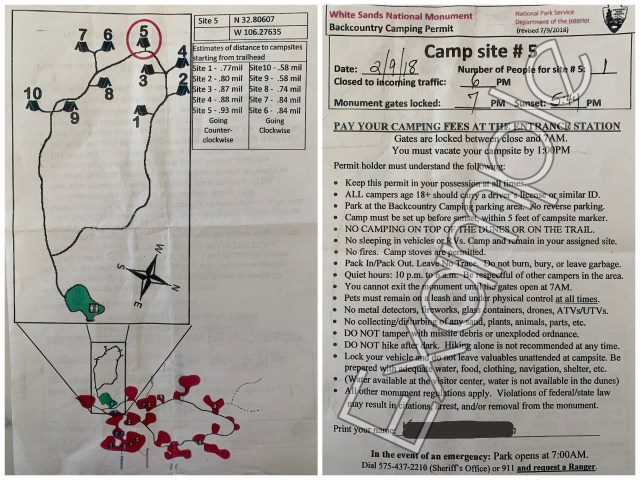
Camping with Dogs at White Sands National Park

Camping with dogs at White Sands National Park is super rad. You’ll get sand everywhere. For all of eternity. It’s worth it. Just go.

Two dogs flank a human sitting on a white sand dune with a purple sunset and mountain in the background while camping with dogs at White Sands National Park

Visiting and Camping with Dogs at White Sands National Park

I may earn commission or revenue on some items through the links below. This does not affect your price or savings. I appreciate your support!

January 25, 2024 Update – Per the White Sands National Park website: Backcountry camping is currently closed due to rehabilitation of camping sites. No date has been determined for its reopening.

Our trip started with a speeding ticket out in the middle of seemingly nowhere when I was legit trying to follow the speed limit. Somehow, I missed a sign. Herc was NOT pleased with the cop approaching my window. All sorts of ferocious woofs and growls coming from the peanut gallery: “Who the heck do you think you are trying to give things to my mom?! Did I say you could approach the vehicle?? Scram! Skedaddle!”

Beyond that minor incident and the fact the Cool Whip was appalled that she had to carry a pack, we had an incredible adventure. White Sands National Park is a beautiful dog friendly area to explore.

White Sands National Park is just outside Alamogordo and the Holloman Air Force Base. It is about six hours from Phoenix. I considered adding the Organ Mountains to our trip, but I opted for City of Rocks State Park. But whether you add more pit stops or not, this unique desert spot is worth the trip.

The dunes are made of white gypsum, a fair bit different from the classic brown sand of Great Sand Dunes National Park. Sunrise and sunset are excellent times to see the dunes as they take on the colors of the sky.

Activities at White Sands include the following and more:

  • Hiking. Dune Life Nature Trail, Playa Trail, Interdune Boardwalk, Alkali Flat Trail, Backcountry Camping Trail
  • Sand Sledding. Bring your plastic snow saucer or purchase one at the visitor center
  • Picnicking. There are shaded tables and grills with nearby restrooms in the parking areas
  • Backcountry Camping. There are no drive-up sites or RV camping options, but you can still spend a night in a tent
Two dogs flank a human sitting on a white sand dune with a sunset and mountain in the background while camping with dogs at White Sands National Park

​Check the Weather and the Missile Launches

Visiting White Sands in February treated us to minimal people and great weather. But, like planning a backpacking trip at Petrified Forest National Park, you’ll want to keep an eye on wind speed and temperature. There will almost always be wind. 10-15 mph is average, but use caution when rates hit 25 mph or greater.

The temperature at White Sands can also get a little extreme. Summer temps average 95 during the day and 55 at night. Winter cools down to 60 as a high and lows down to 23.

And yes, be sure to check for any planned missile range testing. White Sands Missile Range surrounds White Sands National Park. Missile range tests occur about twice a week. The monument and part of highway US 70 may be closed for an hour or two during this time.

A white dog in a blue sweater; the dog has one ear lifted in the wind

​Reservations, Permits, and Cost for Camping with Dogs at White Sands

Camping at White Sands requires a permit. You cannot make a reservation or acquire a permit for a White Sands backcountry campsite until the morning of your overnight adventure. Verify hours of operation before you plan to arrive. Stop at the entrance fee station to obtain your permit.

Rangers assign the ten available camping spots on a first-come-first-served basis. Camping fees are $3.00 per person aged 16+ and $1.50 for those 15 and younger. You’ll pay this fee AND the general entrance fee of $25.00 per vehicle (waived if you have the national park pass) at the entrance station.

You must leave your site by 1:00 pm the next day, and you must request a new permit in person if you wish to stay another night.

A paper showing a map of the backcountry trail and campsite at White Sands National Park and another paper that serves as a permit for backcountry camping with dogs at White Sands National Park

​Poop: Your Dog and YOU

Yes, you have to scoop ALL the poop. Always practice the Leave No Trace principles. Check with a park ranger at the Visitor Center for a Wag Bag if you didn’t bring a waste disposal container. Or, as one crafty ranger recommended to me, you can use the bags they provide at the pet waste stations around the park (one of which happens to be located right in front of the visitor center). These pet waste bags are pretty large and sturdy, by poop bag standards, not skimpy ones that tear if you pick up more than one poop nugget.

Shop: These are the Earth Rated dog poop bags I use.

A pet waste station with a sign on the garbage can noting a graphic of a snake and the word "Rattlesnakes"

The Backcountry Camping Trail

You checked the weather, acquired a permit, loaded up on poop bags, took one last potty break at the toilets by the trailhead parking lot, and now you’re ready to head out on your adventure—woohoo!

The backcountry camping trail is a 2-mile lollipop loop that goes up, over, down, and around many dunes. With the ever-changing nature of the dunes, there is no regular trail on the ground you’ll follow. Instead, you follow orange trail markers staked into the dunes.

Once you reach your first marker on the trail, do not continue moving forward until you see the next marker. Continue this way for the remainder of the backcountry trail. Remember, you’re in a giant sandbox with no other landmarks to guide you, so it’s easy to become disoriented and lose track of your direction. Additionally, GPS tracks have a hard time displaying accurate readings out here. So, always stay aware of where the next trail or campsite maker is staked.

A White dog standing next to an orange stake sticking into a white sand dune; the stake has graphics depicting the rules and marking the route for the backcountry trail at White Sands National Park
A brown dog with an orange backpack standing next to a wooden trail marker stuck into the white sand dune

Campsites at White Sands

​You’ll eventually see the campsites noted on the trail markers as you’re cruising along the trail. Each campsite is in an open valley among the dunes. Once you find your campsite number on a trail marker, look for another marker at the base of the dunes. This is where you’ll set up camp, keeping your tent within five feet of that stake on the valley floor.

An orange trail marker stake and a wooden trail marker stuck into a white sand dune; between the trail markers you can see a green tent in valley down below; this is a campsite when camping with dogs at White Sands National Park
View of white sand dunes under a cloudy sky, tucked into a valley in the dunes is a barely visible green tent; a great site for camping with dogs at White Sands National Park

Camping With Dogs at White Sands National Park

ALWAYS keep your dog leashed while visiting White Sand National Park, even at the backcountry site. There are plenty of lizards and other animals around that you don’t want your dog to disturb. Additionally, you need to be able to find their poop to pack it out.

What to bring when camping with dogs at White Sands:

  • Water. There is NO water out in the dunes. Not even a stream. Make sure you bring plenty for yourself and your dog. Even if the temperature is cool, hiking across the dunes takes some effort.
  • Water bowl. Cool Whip and Hercules can drink out of my hydration pack spout, but a bowl is a lot easier. Here are some of the travel dog bowls we’ve used for hiking and backpacking.
  • Poop bags. Yes, I’m mentioning them again. Don’t be THAT person leaving poop around for others to stumble upon. Don’t bury it either. With all the wind blowing things around, it will resurface in no time.
  • Warm gear. The wind can cool you down a lot during the day, and it gets quite a bit cooler at night. Make sure your pup is comfortable. Bring a warm coat and a blanket or sleeping bag for your dog to snuggle into at night. Other than during our hike out to the campsite (mid-afternoon in February), Cool Whip and Hercules wore their fleece jackets the entire time.
  • Dog backpacks. These aren’t totally necessary, but they are helpful. Cool Whip and Hercules carried their own food and fleece sweaters. Herc is wearing the Ruffwear Approach Dog Backpack.

Now get on out there and have some fun!

Looking down at two dogs, a white pit bull with a black backpack and a red stripped scarf, and brown pit bull with an orange backpack and teal striped scarf; the dogs are on leashed and standing on white sand

Camping in the NHAL State Forest in Wisconsin

If you’re looking for that quintessential Northwoods camping experience with big trees, lakes, and wildlife, camping in the NHAL State Forest is it. The Northern Highland–American Legion (NHAL) State Forest is a beautiful space in northern Wisconsin.

A brown pit bull in camping themed pajamas sitting among pines trees along the shore of Carol Lake while camping in the NHAL State Forest in Wisconsin

Camping in the NHAL State Forest

There are many options, so this truly depends on what you’re looking to do and what type of amenities you want. Most of these campgrounds have sites you can reserve.

Modern Campgrounds

Want to be able to shower and use a regular flush toilet? These are the campgrounds you’ll need to check out. There are no electrical hookups, but you can get a free permit to run a generator if that’s your thing.

  • Clear Lake
  • Big Musky
  • Firefly
  • Crystal Lake

Rustic Campgrounds

Just the essentials—hand-pumped water, pit toilets, and no electricity. However, these campgrounds usually offer wider site spacing than the modern campgrounds. This is what we opted for. Six campgrounds in this list (East Star through West Star) were non-reservable as of Fall 2020.

  • Big Lake
  • Buffalo Lake
  • Carrol Lake
  • Cunard Lake
  • Indian Mounds
  • Plum Lake
  • Sandy Beach Lake
  • South Trout
  • East Star Lake
  • North Trout Lake
  • Razorback Lake
  • Starrett Lake
  • Upper Gresham Lake
  • West Star Lake
Two pit bulls in fleece sweaters sitting between two large pine trees on the shore of Carrol Lake while camping in the NHAL State Forest in Wisconsin

Primitive Campgrounds

Just the basics—tent clearing, fire ring, picnic table, box latrine.

  • Allequash Lake
  • Bittersweet Wild Lakes Area
  • Clear Lake
  • Day Lake
  • Nebish Lake
A view from a wooden dock looking out at a small, tree-filled island on Carrol Lake

Backcountry Camping in the NHAL State Forest

For those looking for even more solitude and adventure, you can request a permit for backcountry camping.

Camping with Dogs at Carrol Lake

While having a shower sounded luxurious while camping, we wanted a small campground—this meant fewer amenities, fewer people, and more seclusion (for the dogs and us). Carrol Lake won partially due to availability when we made our reservation and because it has some tremendous walk-in sites.

Two pit bulls in fleece sweaters sitting between two large pine trees on the shore of Carol Lake while camping in the NHAL State Forest in Wisconsin

Don’t worry; you’re not going to be hauling gear across a football field. It’s more like walking the length of your house (if you have a small, 1300-sq-ft house like me). Easy peasy.

Related Post: What to Pack for a Road Trip with Your Dog

Our site, 102, had a lot of room and a lovely view of the lake. If all the sites there had been open, I might have chosen 103 because it had a little more grassy space and a more open view. However, it was slightly closer to the boat ramp (not that the boaters were noisy, or at least it didn’t sound like it from 102). Site 101 was a bit uphill from us, so more seclusion, but closer to the road. Even from our site, you could occasionally hear cars (noisy ones).

Two pit bull dogs in fleece sweaters on a dock with trees in the background at Carrol Lake lake in Wisconsin
A tan, orange, and grey 6-person tent surrounded by pine trees at a campsite at Carrol Lake Campground in Wisconsin

There were also regular campsites you could pull right up to and a few other walk-ins at the other end of camp. I don’t think those walk-ins had a great view of the lake. Plus, on our side (101-103), we were closer to the docks and dog-accessible waterfront. The actual beach area farther into camp does not allow dogs.

Carrol Lake is just a few minutes from town (Woodruff) and Clear Lake Campground, which has a ranger station and access to firewood.

Note: Pets must be on a leash. A State Parks and Forest sticker is required for camping (throughout the NHAL State Forest).

Brats cooking in a pan over a campfire, a great meal while camping in the NHAL State Forest in Wisconsin
A person sitting along the Carrol Lake lakeshore framed by pine trees and deciduous trees

​Hiking in NHAL State Forest

Our camp host gave us a great local newspaper guide filled with things to do, from local shops to local hikes. The Wisconsin DNR also has a great breakdown of hikes in NHAL State Forest. Try to check in with local guides whenever you can, whether it’s your camp host, a ranger, or some locals in town. They typically have a better grasp of current conditions and what’s accessible, plus they may have some “locals only” trail knowledge they can pass on.

A woman an a hiking trail surrounded by many green leafy trees in the NHAL State Forest in Wisconsin

While we spent part of our trip exploring the Porcupine Mountains Wilderness in Michigan, we did some local hiking as well. We headed up to Escanaba Lake for the first part of our day and then explored Minocqua in the second half. The Escanaba Hiking Trail offers several loops, from 2.36 to 8.48 miles. The trails are well-maintained and relatively wide. There is some logging regrowth you’ll hike through, but most of the time, it’s just beautiful forest views along with an occasional lake sighting.

Also, bring mosquito spray. There were zero bugs at our Carrol Lake campsite, but we encountered quite a few on the Escanaba hike.

Extra also: Don’t forget to bring some local(ish) brewskis!

A golden yellow and orange sunset view of Carrol Lake in Wisconsin
A handing holding a blue can of beer and in the background are two dogs sitting among pine trees with a lake and sunset behind them

Camping at City of Rocks State Park NM

Add camping at City of Rocks State Park in New Mexico to your to-do list. This is the type of place that blows my mind. A seemingly random, relatively small space that stands out in stark contrast to the surrounding landscape. Small but mighty.

Two pit bulls in blue fleece sweaters looking out a field of large stone pillars while camping at City of Rocks State Park NM

Visiting City of Rocks State Park

You’ll roll into the area on some quiet highways and paved roads south of Silver City and north of Deming, passing Faywood Hot Springs, a small resort with – yes, you guessed it – hot springs.

City of Rocks doesn’t even appear until you’re practically right at the front entrance of this massive cluster of giant boulders melting into each other. This monolithic structure is volcanic rock. Wind and water etched the formation over time, leaving smooth, rounded surfaces.

Two dogs in front of a red wooden sign stating "Welcome To City of Rocks State Park" that is held up by two stone pillars; this is what you'll see when you arrive to go camping at City of Rocks State Park NM

As always, I recommend making the visitor center your first stop for park information. The rangers on duty can give you up-to-the-minute details along with the usual items like a park map and souvenirs. I let them know I had two dogs and asked if I should be aware of anything besides keeping them on leash throughout the campground.

They told me they had spotted a mountain lion nearby the day prior, and that elk and bear were in the area, so I should keep a close eye on my pets. ​Of course, when they met Cool Whip and Herc later, they realized we didn’t have quite as much to worry about as if they’d been small, snack-sized dogs.

Two pit bulls in blue fleece sweaters looking out from a cave while camping at City of Rocks State Park NM

Camping at City of Rocks State Park New Mexico

You can’t pick a bad spot in this New Mexico state park, but our friendly park ranger did offer a couple of recommendations to help us stay out of the wind that day. Just one of the many reasons to make time to talk with the local rangers. It’s their job to know these parks so they can provide information to park visitors.

​An individual campsite costs $15.00 per night (non-electric). You can make reservations for some campsites, but others are first-come-first-served only. I wasn’t visiting during peak season, and I didn’t need electrical hookups, so I relied on the FCFS options.

Each campsite has a picnic table and campfire ring. Garbage cans and pit toilets are tucked throughout the campground. The visitor center has flush toilets and showers if you want to feel fancy.

A campsite with one deciduous tree, a campfire ring, and a red wooden sign state #5 and the word Aquila with a rock landscape in the background, a great campsite if you're camping at City of Rocks State Park NM

Cell Reception at City of Rocks

I didn’t have cell reception throughout most of City of Rocks State Park.

So, then what do you do when it starts pouring rain right after you pull into your campsite? ​Like your-tent-isn’t-even-set-up-just-pulled-in.

You turn your vehicle into your tent. Redistribute a few gear bags, blow up some sleeping pads, and spread out sleeping bags. Kick back and relax.

I listened to my downloaded podcasts. And, ironically, this is when I came across How to Unplug with Danny Kim, episode 100 from Wild Ideas Worth Living. It covered exactly what had been running through my brain: Do we need to unplug, and, if so, how can we?

Honestly, to answer that, I’d just be repeating what I heard on that podcast, so give it a listen for yourself. Trust me, it’s worth listening to.

Because once the sun did come back out and I inadvertently found cell service while hiking, I resisted the urge to jump on social media. I heard a few notification dings, then turned my phone on silent. And challenged myself only to use my phone for pictures until I left City of Rocks the next day. It was refreshing!

Two dogs, a brown pit bull in a blue sweater on the left and a white pit bull in a unicorn sweater on the right, facing the camera while standing up on a rock ledge
A brown pit bull dog peering out through a crack between two large rocks

Is City of Rocks State Park Dog Friendly?

Yes, City of Rocks State Park is very dog friendly! Once the rain cleared, we scurried all over the park. The whole place is dog-friendly, aside from inside the buildings. There are hiking trails (Hydra Trail and Table Mountain Trail), but we mostly stuck to scrambling around on the boulders because there seemed to be endless nooks and crannies to explore.

Whether this is a destination or a pitstop on a more extensive adventure, I highly recommend it. After backcountry camping at White Sands National Park, we spent the night here. And I’ll definitely stop again if we’re cruising through southwestern New Mexico.

A brown pit bull dog in a sweater looking out over a rocky landscape with sunrays shining out just above his shoulder

Dog-Friendly Camping in Alabama Hills

Who pooped in the van?

Never ever is that a question you want to have to ask.

A woman and two pit bulls standing on large granite boulders

I may earn commission or revenue on some items through the links below. This does not affect your price or savings. I appreciate your support!

View of an arch in granite boulders with snow capped Sierra Nevada mountains in the background

We were in a rental adventure van, bouncing along on a dusty washboard road just east of the Sierra Nevada Mountains. We had been scurrying about a field of granite boulders in search of arches, which we found. But they are not the highlight of this story. The poop isn’t the highlight of the story either. Well, maybe it is. But at the very least, it was a somewhat pivotal moment.

A pit bull in a blue coat standing on granite boulders looking ahead to sunrise while camping in Alabama Hills
A brown pit bull in a blue jacket and green harness staring ahead at snow capped mountains lit up by sunrise

Herc hadn’t pooped in two and a half days. He has not-pooped on an adventure before, but usually just for a day. But there I was in the middle of day three, exploring out beyond the popular areas, circling and circling and mumbling about poop. “C’mon Hercy, time to do some pooping. How about this bush? It looks perfect for backing your little booty into! No? What about this one? Yes, I know we passed it three times already and you peed on it twice, but I just need you to poop. I’ve seen you eat all your kibbs, so I know you have stuff to deposit!”

After an eternity – rough estimate – I aimed us for the van and wondered if there were any vets in Lone Pine. The leash caught on something. Ugh, what now?! I spun around and saw Herc leaving a giant number two. Finally! I’ve never been so excited to see poop! “Herc you are such a good fella! I am so proud of you! Good boy! Good boy!!” We pranced back to the van and started our bumpy journey to base camp.

A woman and two pit bulls walking along a brown granite ridge while camping in Alabama Hills

Sniff sniff.

No.

Someone must have farted.

Sniff sniff.

More farts?

Sniff.

Dang.

Really hounds? It’s only Friday and had this van until Wednesday.

Cool Whip had the most smug look on her face. For once, she was the innocent one. Herc just looked out the window.

Settling In at Basecamp

Back at basecamp I shook out the bedding, sprayed disinfectant everywhere, and aired out the van. Thankfully, it was an easy cleanup and I knew it could have been worse. Much, much worse. So, I cracked open a drink and settled into my camp chair. We were “home” and that made everything okay.

I was surprised how quickly I felt at home in our rental rig and location. Because one night for each was all it took to feel that cozy sense of belonging. Skipping down the sandy road to see our vibrant van seemingly pop out of nowhere amongst the rocks brought on an internal hug.

A woman and two pit bulls standing in a field of granite boulders while camping in Alabama Hills

Finding Sites for Camping in Alabama Hills

The locations I’d originally pinned on a map as potential basecamps were all occupied when we arrived – camping in Alabama Hills is popular. I, of course, panicked a bit. Had I not prepared properly? Or, had I grossly misjudged our options? And what if I couldn’t find any parking spots? Unnecessary worrying. The more I explored, however, the better options I found. I found more seclusion, better views, and nicer roads. Patience is key, Kris, which is what I must remember.

Our camp was tucked well into the boulders with a circular entryway. So, I’d never have to back in awkwardly. By parking in just the right spot, we could settle around the campfire with a bit of privacy. Which really meant the dogs would not get worked up by any vehicles driving past. Peaceful, calm, and undisturbed.

And surrounded by these magical, wonderful boulders bubbling out of the earth with rounded corners and gently creased folds. Surfaces are textured just enough to grip your feet without roughing them up. An epic geological playground. Each day we scrambled over and meandered around these boulders, weaving in and out of the granite hallways. Never the same route twice, though we did find a few favorite destinations for the rising and setting of the sun. It was a welcoming coziness in this jumble of rocks.

Learn more about Alabama Hills.

Exploring California’s Alabama Hills with Your Dog

Boot shaped arch in granite rocks
a brightly colored van parked in a dirt clearing surrounded by large granite boulders

Dog-Friendly Camping in Alabama Hills: What to Pack

Dog-friendly travel doesn’t have to be a challenge. Here are a few of my favorite things to pack for a camping trip with the dogs.

Travel Dog Bowls

Leave the heavy, rigid dog bowls at home. Look for lightweight, packable bowls that save space and won’t break. I like no-spill bowls for water and collapsible bowls for food.

Dog Bed

Skip the big, chunky dog beds unless your pup needs the orthopedic advantages. Travel dog beds usually include waterproof or water-resistant materials. Also, they can be packed down to save space.

Waste Bags

Sounds like a no-fun item, but waste bags are essential when camping in Alabama Hills. Here in the desert, it takes longer for waste to decompose, and in a highly trafficked area like this, it is even more important to keep from adding to the damage and protect the environment. Always follow leave-no-trace principles to protect these special places.